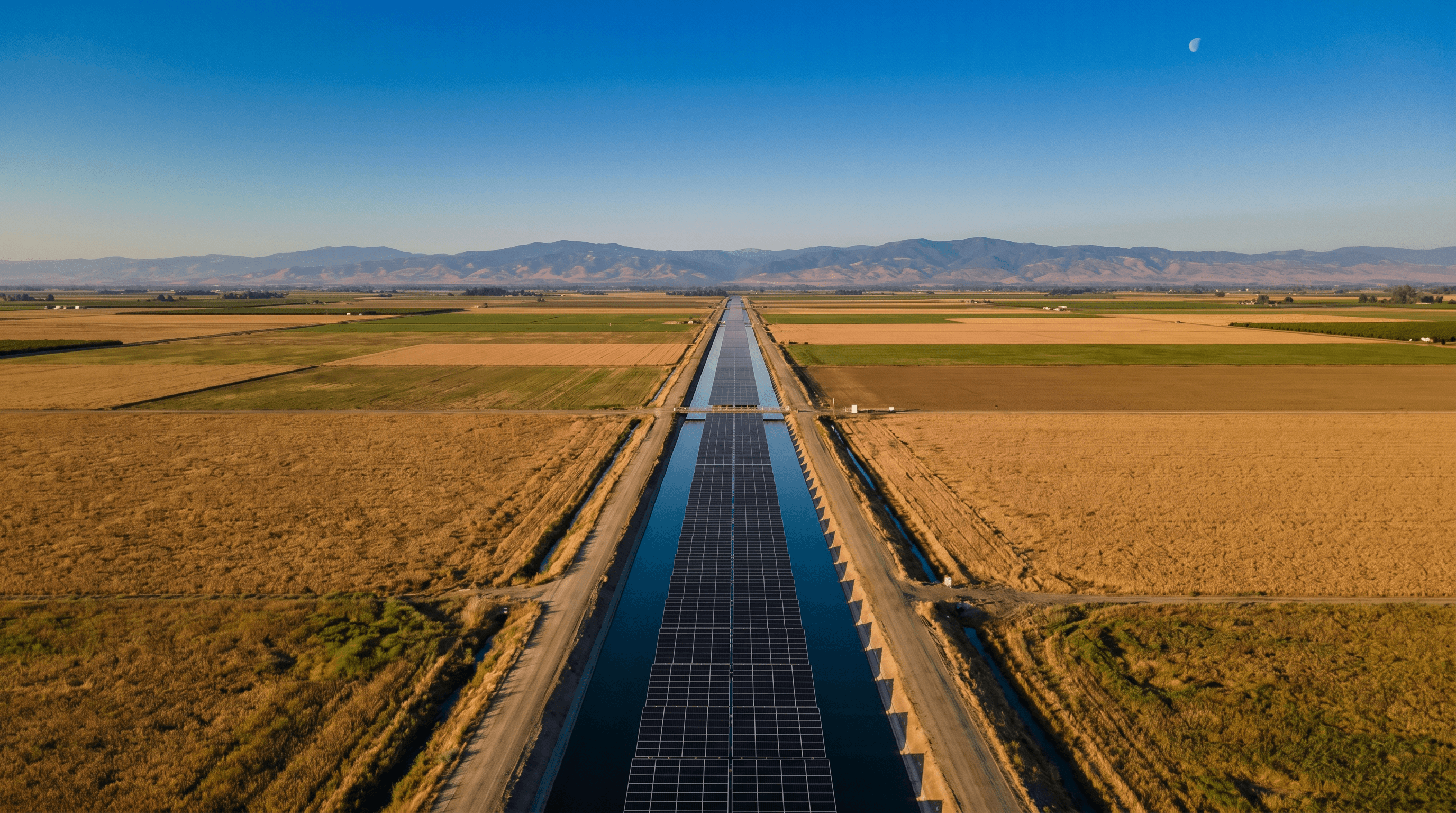
Two things happened in the solar world that did not make nearly enough noise in mainstream coverage. In January 2023, Caltech launched a small satellite that did something no one had done before: it beamed solar energy wirelessly from orbit back toward Earth. And by August 2025, a quiet stretch of irrigation canal in California's Central Valley was fully shaded by solar panels — generating power, conserving water, and suppressing weeds all at once. These are genuinely significant developments. They are also both, in their own ways, early-stage stories that require a careful read before drawing conclusions.
From our vantage point as a residential solar installer in Eagle Rock — four miles from Caltech's Pasadena campus — we watch both of these frontiers with real curiosity and, frankly, healthy skepticism. We are not engineers working on orbital power systems or canal infrastructure. But we do talk to SoCal homeowners every week who want to know where solar is headed, and whether any of it changes what they should be doing on their own roof right now. That is the question this post tries to answer honestly.
"To the best of our knowledge, no one has ever demonstrated wireless energy transfer in space even with expensive rigid structures." — Ali Hajimiri, Caltech, on the SSPD-1 milestone (Caltech News, June 2023)
Space-based solar: what Caltech actually proved — and what the math still says
In January 2023, Caltech launched the Space Solar Power Demonstrator (SSPD-1) — a small experimental satellite funded by a $100 million gift and carrying three distinct experiments. When the mission ended in November 2023, two of those experiments had produced results worth paying attention to. The third exposed a real engineering problem.
What SSPD-1 actually demonstrated
The MAPLE experiment — a microwave power transmitter array — achieved something that had never been done before. Per Caltech's June 2023 announcement, MAPLE confirmed wireless energy transfer from orbit: a signal was received at the correct time, at the correct frequency, with the predicted Doppler shift, on the roof of Caltech's Gordon and Betty Moore Laboratory of Engineering in Pasadena on May 22, 2023. According to Caltech's January 2024 end-of-mission report, the mission successfully validated three technologies: MAPLE (wireless power transmission), DOLCE (a deployable structural system), and ALBA (a comparison test of 32 types of photovoltaic cells under space conditions). The mission report describes MAPLE as having "successfully beamed power wirelessly in space and directed a beam toward Earth — described as 'a first in the field.'"
That said, the IEEE Spectrum's April 2024 analysis of the mission — based on an interview with Caltech's Ali Hajimiri — provides an important qualifier. MAPLE's small array spread transmitted power over a large ground area, capturing only a small fraction at the receiver. IEEE Spectrum characterized the result as a "detection" rather than net-positive power transfer: the signal was confirmed, but the amount of energy reaching the ground was not enough to call it a power delivery system in any practical sense. Caltech's own end-of-mission reporting notes that DOLCE's deployment mechanism snagged on a wire — a failure mode never encountered in lab testing — and that MAPLE experienced power transmission degradation over time. Actual space conditions revealed, in the mission report's own words, "blind spots" in design predictions.
No SSPD-2 launch date has been publicly announced. As of the Caltech Space Solar Power Project news page, checked in May 2026, the most recent entry is from September 2024 — no subsequent mission announcements are present.
Separately, Northrop Grumman has a Space Solar Power Incremental Demonstrations and Research (SSPIDR) program working on directed RF energy transmission to ground-based rectennas. Public details on specific demonstration outcomes are limited in materials we could verify, so the technical readiness of SSPIDR remains an open question for outside observers. JAXA, meanwhile, has a published roadmap calling for a 1-gigawatt commercial space solar system, with ongoing microwave and laser transmission research described on its current research page — but whether JAXA's intermediate roadmap milestones have been met is not confirmed by any source we can verify.
The cost and engineering gap that NASA's own analysis documents
The milestone achievements are genuine. What follows them is a much harder problem, and NASA's own Office of Technology, Policy, and Strategy was unusually candid about it in its January 2024 space-based solar power report.
According to that report, as analyzed by IEEE Spectrum in May 2024, a commercial space solar power station would cost at least $275 billion to build — the first one. Under optimistic launch-cost scenarios, electricity from a space solar system "would be six times as expensive as NASA's projected cost for a terrestrial solar farm outfitted with battery storage." Under less optimistic scenarios, the cost gap widens to 12 to 80 times more expensive than terrestrial alternatives, even if systems came online by 2050. End-to-end efficiency — the fraction of solar energy collected in space that actually reaches an end user — is currently estimated at approximately 11%. That means you would need to collect roughly 9 gigawatts in orbit to deliver 1 gigawatt to the grid.
The engineering challenges compound the economics. According to the same IEEE Spectrum analysis, a commercial station would require transmitter arrays measuring at least 750 meters across in geosynchronous orbit, and ground receiver stations covering more than 34 square kilometers. Phase-array synchronization across that entire structure would need to be accurate to just a few picoseconds. NASA's 2024 report assessed that ten of the 13 critical subsystems required to build such a satellite rank as "high" or "very high" technical difficulty. Commercial viability would require achieving all of the following simultaneously: a two-thirds reduction in launch costs beyond improvements already achieved; solar cell efficiency reaching 40% (current best is around 32%); and 90% cost reductions in the specialized maintenance spacecraft that would need to service an orbital array.
None of this means space-based solar is impossible. The Caltech and Northrop Grumman demonstrations are legitimate steps on a very long road. But it does mean it is a 2040-to-2060 story at the absolute earliest — and that is using the optimistic assumptions. We say this not to dismiss the research, but because the honest framing matters: the same sun that researchers are trying to harvest from orbit is already falling on your roof right now, at costs that are fully understood and do not require solving ten high-difficulty engineering problems first. The work happening at Caltech and Northrop Grumman matters for the long arc of the energy transition. It does not change the math on a residential solar installation in Los Angeles in 2026.
For more on how large-scale electricity demand shifts are already affecting SoCal homeowners' bills today, our piece on AI data centers and California electricity costs covers the near-term pressures that are very much already priced into your utility statement.
California's canal solar: a more grounded breakthrough — and what the data shows
If space-based solar is a 2040+ story, California's canal solar program is something quite different: an infrastructure concept with a completed pilot project, real field data, and a growing state and federal push behind it. The numbers coming out of Project Nexus — the nation's first solar-covered irrigation canal — are genuinely interesting, even as the program is still very early in its scaling journey.
What Project Nexus built — and what it found
Project Nexus covers two sections of irrigation canals operated by the Turlock Irrigation District in Stanislaus County — one site near Hickman, one near Keyes. The narrower Hickman site, covering a 20-foot-wide canal, was operational by March 2025. The wider Keyes site — a cable-suspended structure spanning a 110-foot-wide canal — completed construction by August 2025. Together, the two sites total less than two miles of canal covered, generate over 1.6 megawatts of renewable power, and include 75 kilowatts of iron-flow battery storage. The project was built with a $20 million investment from California's Department of Water Resources, with partners including Solar AquaGrid LLC and UC Merced. It received the Edmund G. "Pat" Brown Award from the California Council for Environmental and Economic Balance in 2024, recognizing the project's balance of environmental and economic aims.
The early field data, published by UC Merced's newsroom on April 29, 2026, is the most current read on what actually happens when you shade a canal with solar panels. UC Merced researcher Brandi McKuin, who has studied this concept since the original 2021 modeling study, described the results: "We're seeing quite a lot of reductions." Specifically, field monitoring shows up to 70% less evaporation in shaded canal sections and 85% less aquatic weed growth. Those are measured results from real operational conditions — distinct from the earlier modeled projections.
That earlier modeling work is worth understanding separately. A 2021 Nature Sustainability paper by UC Merced and UC Santa Cruz researchers — the foundational study that has since been cited by TID, Solar AquaGrid, and the state DWR in building the case for canal solar — projected up to 82% evaporation reduction from covering canals. The 82% figure was a modeled maximum for full or near-full canal coverage under optimal conditions. The 70% figure from Project Nexus's 2026 field data reflects actual measurement at a specific site with real-world variables. The two numbers are not contradictory — they tell a consistent story of meaningful water conservation — but they are distinct findings from distinct methodologies, and it is worth keeping them clear.
The scale question: what covering all of California's canals could look like
The 2021 UC Merced Nature Sustainability paper modeled what would happen if all of California's approximately 4,000 miles of exposed irrigation canals were covered with solar panels. The results were striking enough that they have anchored the policy conversation ever since: 13 gigawatts of solar generating capacity, 63 billion gallons of water saved annually — enough to irrigate 50,000 acres or supply 2 million households — and approximately $40,000 per canal mile per year in maintenance cost savings from reduced aquatic weed growth and other operational reductions.
To put 13 GW in context without overstating it: California now has 53 gigawatts of installed solar capacity — enough to power more than 15 million homes — according to the SEIA/Wood Mackenzie Q3 2025 market report. The state installed 255 megawatts of residential solar in Q1 2025 alone. So 13 GW from canals would represent a meaningful increment — roughly one-quarter of what California has built across all solar categories over many years — concentrated in the agricultural regions where water is most precious and land is already spoken for. The canal solar concept is compelling precisely because it stacks benefits: the panels do not consume farmland, the shade reduces water loss, and the electricity feeds local irrigation pumps or the broader grid.
Project | Status | Canal Covered | Power Output | Key Partners |
|---|---|---|---|---|
Project Nexus (Turlock ID) | Fully operational (Aug 2025) | <2 miles (two sites) | 1.6+ MW | TID, CA DWR, Solar AquaGrid, UC Merced |
Delta-Mendota Canal Pilot | In development (funded Apr 2024) | TBD (floating PV) | TBD | Bureau of Reclamation, SLDMWA, UC |
Full statewide canal potential (modeled) | Aspirational — no deployment timeline | ~4,000 miles | ~13 GW (modeled) | — |
The statewide scaling ambition now has an institutional structure behind it. In March 2025, a consortium led by USC Dornsife Public Exchange and Solar AquaGrid — with research faculty from seven universities including USC, UC Merced, UC Berkeley, and UC Irvine, plus collaborators from California's Department of Water Resources and Natural Resources Agency — launched the California Solar Canal Initiative (CSCI). The initiative is focused on identifying viable canal-solar deployment sites across California, addressing the regulatory and infrastructure questions that come with scaling beyond pilot projects, and supporting the state's clean energy goals leading up to 2045. In parallel, in April 2024, the Bureau of Reclamation and its partners received $15 million in federal IRA funding for a floating photovoltaic pilot on the Delta-Mendota Canal in Merced County — a second proof-of-concept site with a different technical approach.
"We were surprised by the significant evaporation savings, which we project to be as much as 82%." — UC Merced researcher Brandi McKuin, on the 2021 Nature Sustainability modeling study that laid the foundation for Project Nexus
The honest timeline for canal solar scaling is still being written. Project Nexus is less than two miles of covered canal. California has 4,000 miles of exposed irrigation canals. Getting from one to the other involves land access negotiations, water district agreements, grid interconnection processes, and engineering at a scale that has never been attempted. The CSCI's work on "regulatory challenges" is not boilerplate — it reflects real complexity. This is a 2026-to-2035 scaling story, not a near-term grid transformation. But unlike space-based solar, the physics are settled, the pilot is built, the field data is coming in, and the policy machinery is moving.
What this means for SoCal homeowners
We think about both of these developments the same way we think about most emerging energy technologies: interesting, worth watching, and completely separate from the decision a SoCal homeowner faces in 2026. Here is why that framing matters.
Space-based solar — if it ever becomes commercially viable — is a utility-scale technology. It would feed power to the grid the way a power plant does. It would not change how your home is wired, what your utility charges you, or whether a rooftop system makes financial sense. And based on NASA's own 2024 cost analysis, the timeline for a commercial space solar station is measured in decades and hundreds of billions of dollars. The demonstrations from Caltech and Northrop Grumman are real engineering milestones. They are not near-term grid contributors.
Canal solar is a closer story, and a more relevant one for California energy policy. If the CSCI successfully maps deployment sites and the regulatory pathway opens for canal coverage at scale, it could add meaningful renewable capacity to California's grid over the next decade — concentrated in the agricultural regions that grow much of the country's food and depend on the water those canals carry. That is genuinely good for California's energy transition, and by extension, good for the grid environment SoCal homeowners operate in. But it is an agricultural infrastructure story, not a residential rooftop story. A canal in Stanislaus County generating power for Turlock Irrigation District does not directly reduce what you pay SCE or LADWP in Eagle Rock or Pasadena.
What does change your bill — right now, in 2026 — is the electricity you generate on your own roof and store in your own batteries. California has 53 gigawatts of installed solar for a reason: the sun in Los Angeles is among the most reliable and abundant in the country, rooftop solar costs have dropped dramatically over the past decade, and utility rates have climbed to the point where every kilowatt-hour you make yourself is a kilowatt-hour you do not buy at 34.5 cents from SCE. The 30% federal residential Investment Tax Credit (Section 25D) expired December 31, 2025 under H.R. 1, removing a meaningful incentive that existed for years — but the underlying rate hedge case for solar and battery storage does not depend on federal credits. It depends on the spread between what you pay for grid electricity and what it costs to generate your own.
A solar-plus-battery system — paired with storage options like the Enphase IQ Battery or a Franklin WH system — lets you maximize self-consumption, shift away from peak time-of-use hours, and build a fixed-cost energy asset on your roof that is insulated from whatever the next CPUC rate case brings. The space solar engineers at Caltech are working on a 2040 solution. The canal engineers at UC Merced are working on a 2030 solution. The rooftop option is available to you today, at well-understood costs, backed by decades of installation experience across Southern California.
We follow both frontiers with genuine interest — partly because we are solar people who find the technology fascinating, and partly because Caltech is four miles from our office and their work matters to us locally. But our job is to give SoCal homeowners an honest picture of what actually affects their energy costs and their home's long-term value. Right now, that is rooftop solar. The big-picture stuff is worth understanding. The bill you pay next month is worth acting on.
If you want to know what a solar and battery system would actually look like for your home — including what the numbers look like without the federal ITC — we are happy to run through it with you. Schedule a free solar consultation with Anca Solar. We serve homes across LA, Orange, and Ventura Counties from our office at 4519 Westdale Ave, Eagle Rock, CA 90041. You can learn more about our team and our approach before committing to anything. (CSLB License #873768.)
Subscribe to our newsletter
Sign up to get the most recent blog articles in your email every week.