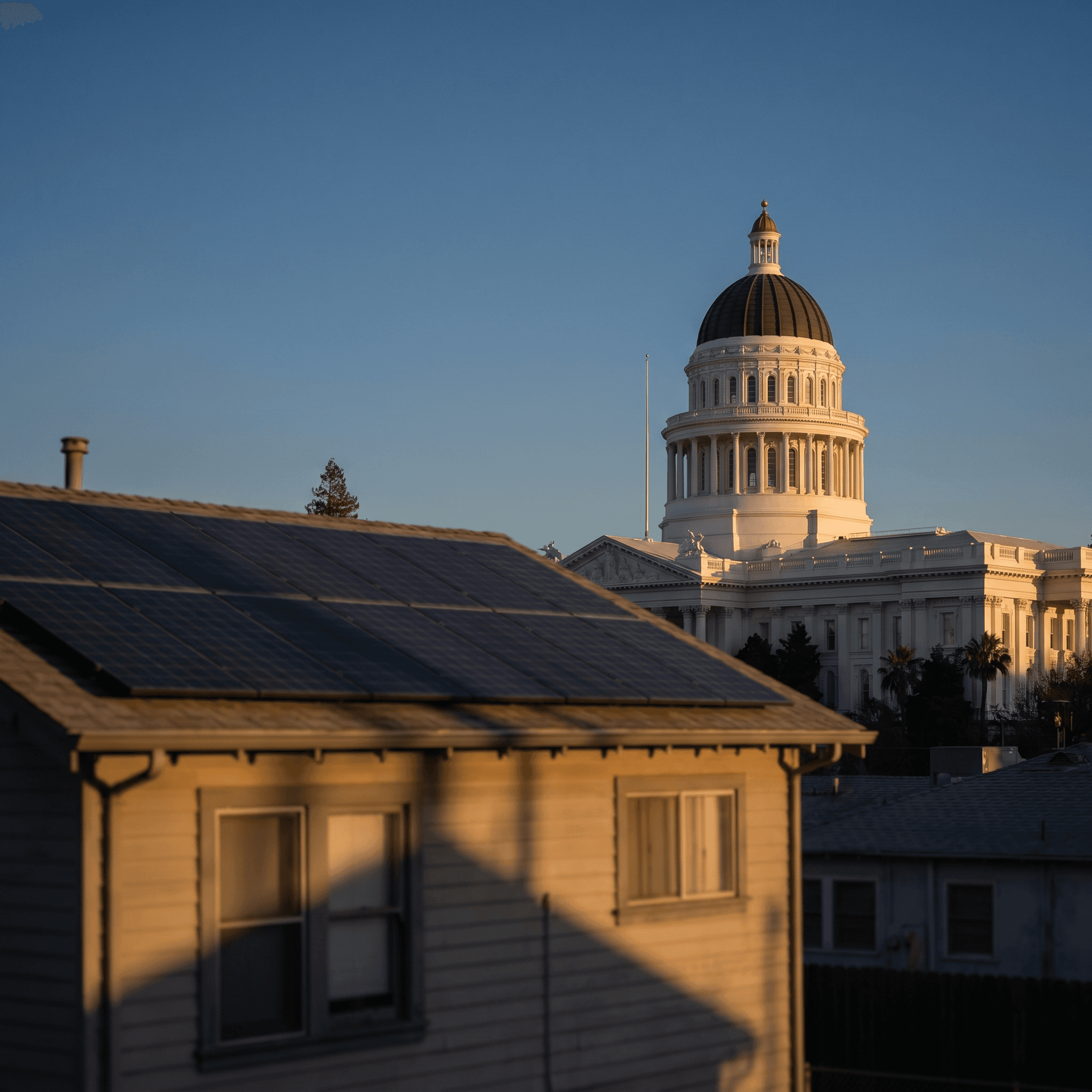
If you have been watching California's community solar program and wondering whether it might offer a simpler path than rooftop solar, this is the update you need. The California Public Utilities Commission issued a proposed decision in early April 2026 that solar industry advocates say effectively ends any real chance of community solar expanding in the state. The CPUC's scheduled vote was set for May 14, 2026. As of this writing on May 15, the outcome had not been independently confirmed in published reporting — but the proposed decision itself is the story.
Two major advocacy organizations — the Solar Energy Industries Association (SEIA) and the Coalition for Community Solar Access (CCSA) — say the proposed decision "virtually ensures no projects will be built." That phrase is the headline of PV Magazine USA's April 9, 2026 coverage, quoting SEIA's California State Affairs Director. Here is what is behind it, and what it means for your home.
What the CPUC's proposed decision says — and why advocates say it does not work
The CPUC's proposed decision was designed to implement Assembly Bill 2316, signed into law in September 2022. The bill directed the CPUC to create a community renewable energy program for California's large investor-owned utilities — primarily Southern California Edison, PG&E, and SDG&E. Community solar is the model where households subscribe to a share of a centrally located solar farm and receive bill credits for their portion of the electricity produced. It is particularly aimed at renters, apartment dwellers, and homeowners whose roofs are shaded or otherwise unsuitable for panels.
The solar industry had hoped the CPUC would adopt a compensation structure called the Net Value Billing Tariff (NVBT), which would have set bill credits at a rate high enough for private developers to secure financing. Instead, per PV Magazine USA's April 9, 2026 reporting, the CPUC proposed the Avoided Cost Calculator (ACC) methodology — a narrower calculation that advocates say is "too low and too volatile" to make community solar projects financially viable. Without stable revenue projections, developers cannot obtain the project loans needed to build.
Key elements of the proposed decision, as reported by PV Magazine USA and Solar Power World (both April 9, 2026):
Net Value Billing Tariff (NVBT) rejected. The industry's preferred compensation mechanism — designed to recognize the full grid value of distributed solar — was not adopted.
Avoided Cost Calculator (ACC) adopted instead. Bill credits will be based on a narrower avoided-cost methodology. Advocates argue this rate cannot support project financing.
Community Solar Green Tariff (CSGT) discontinued for new projects. The existing program, which had served as California's closest working analog to community solar, was ended for new subscribers. Remaining capacity was transferred to the Disadvantaged Communities Green Tariff (DAC-GT) program.
Enrollment procedures and bill savings requirements absent. CCSA's West Regional Director flagged that the proposed decision "omits core elements" needed for a functioning program.
What the two largest solar advocacy groups said verbatim
These are the direct quotes from the April 9, 2026 reporting, which we are relaying factually rather than endorsing as advocacy positions:
"With this proposed decision that crushes any chance of a viable community solar program in the state, the CPUC has wasted a golden opportunity to help lower utility bills for Californians in desperate need of relief from skyrocketing electricity prices." — Stephanie Doyle, SEIA California State Affairs Director, as quoted by Solar Power World (April 9, 2026)
"While it purports to move implementation forward, it does not establish a workable community renewable energy program. It omits core elements such as how to enroll customers, bill savings requirements, low-income participation pathways and alignment with the state's Title 24 building requirements." — James McGarry, CCSA West Regional Director, as quoted by Solar Power World (April 9, 2026)
Doyle also told PV Magazine USA: "The state legislature made it clear in passing AB 2316 that it wants a robust program… instead, the CPUC has issued a decision that virtually ensures no projects will be built." The CPUC's own program pages were not accessible for direct retrieval at the time of research; its position is reflected through these trade press accounts.
What AB 2316 was supposed to do — and why the program has not launched
AB 2316 (Chapter 350, signed September 16, 2022) was California's attempt to build a large-scale community solar market. The law applied to all electrical corporations serving 100,000 or more customers — meaning SCE, PG&E, and SDG&E — and directed the CPUC to evaluate existing programs by March 31, 2024 and formally establish a new community renewable energy program by July 1, 2024 if it was determined to benefit ratepayers. That July 2024 deadline has come and gone without a functioning program in place.
What the law required, per the chaptered bill text (leginfo.legislature.ca.gov):
At least 51% of program capacity must serve low-income customers — defined as those qualifying for CARE, FERA, CalFresh, SNAP, or LIHEAP, or residents of disadvantaged communities as defined under California Environmental Protection Agency standards.
Bill credits based on avoided costs of the facilities, "as determined by the commission's methods for calculating the full set of benefits of distributed energy resources." The legislation itself set the avoided-cost framework — the industry dispute is about how broadly "full set of benefits" should be interpreted.
No cost-shifting to non-participating customers beyond avoided costs.
Prevailing wages required for construction workers on community solar facilities.
The federal funding that was expected to help — and is now gone
California had been awarded approximately $249 million under the EPA's Solar For All program, according to PV Magazine USA's April 9, 2026 reporting. Solar For All was a $7 billion sub-program within the broader $27 billion Greenhouse Gas Reduction Fund created by the Inflation Reduction Act, designed to bring community solar to low-income households. However, on July 4, 2025, President Trump signed the Working Families Tax Cut into law, which repealed Section 134 of the Clean Air Act and rescinded all remaining GGRF funding. Per the EPA's program page, the agency ceased implementation of the Solar For All program on August 7, 2025. That $249 million is no longer available. Any projections for California community solar that assumed federal Solar For All money as a backstop are now operating on a different financial basis.
The NVBT rejection mirrors what the CPUC did to rooftop solar owners in 2023: choosing a narrower avoided-cost framework over one that recognizes the full grid value of distributed solar. If you want the rooftop side of that story, our post on how NEM 3.0 changed the math for SoCal homeowners covers the mechanics in detail.
What this means for SoCal homeowners right now
The practical answer depends almost entirely on which utility serves your home.
LADWP customers: this decision does not apply to you
If your electricity comes from the Los Angeles Department of Water and Power, the CPUC's AB 2316 decision has no direct effect on your community solar options. AB 2316 applies only to electrical corporations with 100,000 or more customers regulated by the CPUC. LADWP is a municipal utility owned by the City of Los Angeles and operates outside CPUC jurisdiction. That said, LADWP does not currently offer a community solar program comparable to what AB 2316 sought to create — so LADWP customers seeking an alternative to rooftop solar have limited utility-level options regardless of this ruling.
SCE customers in LA County, Orange County, and Ventura County
If you are an SCE customer — which covers a large portion of LA County outside the City of LA, plus most of Orange County and Ventura County — the CPUC's proposed decision matters to you. The AB 2316 program as structured in the proposed decision is unlikely to produce functioning community solar projects. However, SCE separately operates a Community Renewables Program that is currently available. Per SCE's program page as of May 15, 2026, the program has approximately 35 MW of active projects (including Sheep Creek and RB Inyokern facilities), with an additional 29 MW expected to come online in Q3 2026. Residential subscribers receive bill credits averaging $0.12260 per kWh. That program appears to be distinct from the new AB 2316 framework — SCE's Community Renewables Program operates under its own Schedule GTSR and was not the subject of this proposed decision.
If you are an SCE customer exploring solar, it is worth understanding that community solar credit rates (~$0.12/kWh) are typically well below the retail rate you pay for grid electricity (~$0.29–0.40/kWh in SoCal in 2026). With community solar you receive credits but do not own generating capacity, do not qualify for battery storage pairing that helps under time-of-use rates, and cannot earn from your own roof's output. For homeowners with a viable roof, rooftop solar in Los Angeles produces a higher bill offset and you own the asset.
One more important note on incentives: the 30% Residential Clean Energy Credit expired at the end of 2025 under H.R. 1 (the One Big Beautiful Budget Act, signed July 4, 2025). Consult a qualified tax professional regarding any remaining federal credits applicable to your installation. On the state side, California's SGIP battery rebate remains active — our post on the SGIP battery rebate in 2026 has current details. Pasadena homeowners on PWP service have an additional opportunity: PWP launched a solar and battery rebate pilot in April 2026 that is independent of CPUC and SCE entirely.
What this means for you
If you were waiting on California's community solar program as an alternative to rooftop solar, the CPUC's proposed decision is a signal that a competitive community solar market is not arriving soon. The Solar For All federal funding is gone. The compensation structure developers said they needed was rejected. The program missed its July 2024 implementation deadline by nearly two years. For homeowners with a viable roof across Los Angeles County, rooftop solar paired with battery storage gives you ownership, meaningful bill reduction under SCE's time-of-use rates, and the ability to stack incentives like SGIP — none of which community solar provides.
At Anca Solar, we have been installing solar across Southern California for more than 25 years. We work with SCE, LADWP, and municipal utilities across the region. If you want a straight read on what rooftop solar would cost and return for your home — with no assumptions about programs that may not materialize — schedule a free solar consultation with Anca Solar. We serve homes across LA, Orange, and Ventura Counties. Learn more about our team before you commit to anything. (CSLB License #873768.)
Subscribe to our newsletter
Sign up to get the most recent blog articles in your email every week.