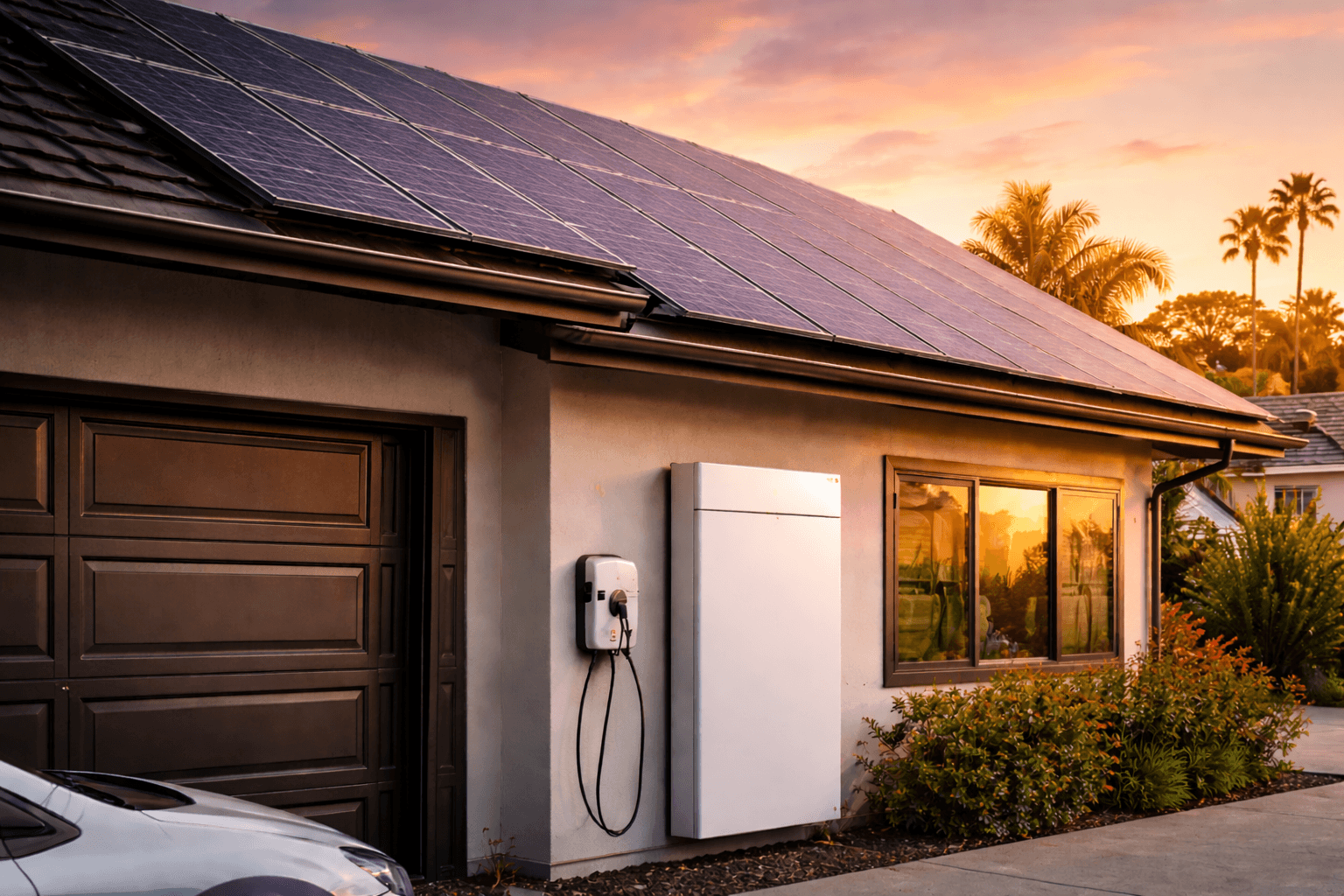
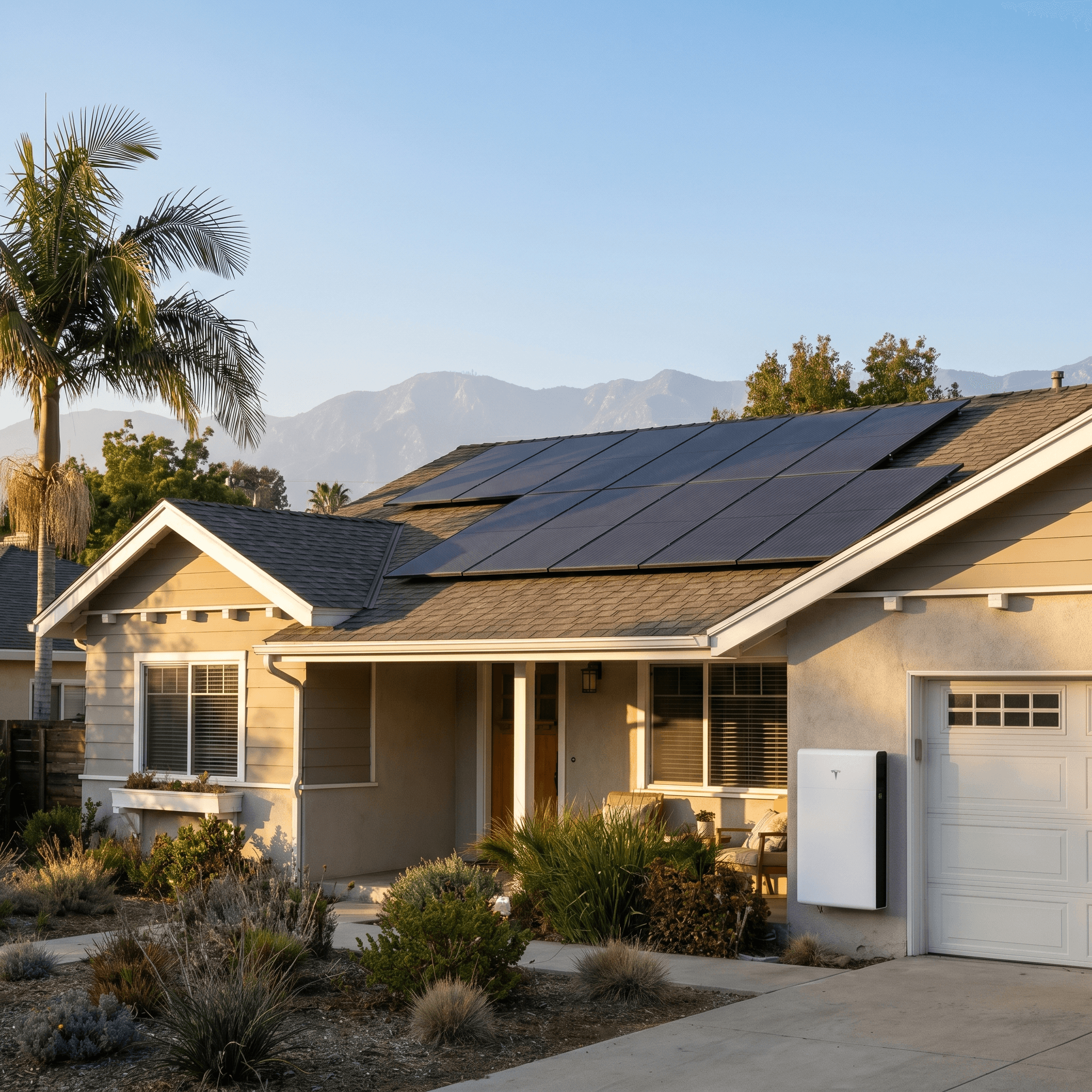
If you own a home in Pasadena and have been watching your electricity bill climb while your neighbors in SCE territory wrestle with unfavorable solar export rates, this is the news you have been waiting for. Pasadena Water and Power launched its Solar and Battery Rebate Pilot Program on April 2, 2026 — a direct cash rebate for homeowners who install new rooftop solar, a home battery, or both.
The headline numbers: $0.60 per watt for solar panels, $350 per kWh for battery storage — with income-qualified customers eligible for $1.00 per watt and $550 per kWh. Program funds are limited. There is no announced end date, but the word "pilot" is there for a reason.
What launched in Pasadena — and why it matters now
On April 2, 2026, Pasadena Water and Power officially launched the "Solar and Battery Rebate Pilot Program" for residential and commercial customers. The program is part of PWP's broader strategy to achieve 100% carbon-free electricity by the end of 2030 — a commitment codified under Resolution 9977. In PWP General Manager David Reyes's own words from the launch announcement:
"Installing a rooftop solar system is an environmentally responsible way for PWP customers to reduce energy use, support Pasadena's clean energy goals, and lower their utility bills."
The pilot builds on PWP's longer-term decarbonization push. Just weeks after launch, PWP issued a Request for Information (May 11, 2026) exploring solar and energy storage at 21 city-owned facilities — including the Rose Bowl Stadium, Pasadena Central Library, and the Convention Center. The residential rebate and the municipal buildout are two sides of the same coin: the rebate program is the homeowner's on-ramp.
If you are considering solar panel installation in the Los Angeles area, living in PWP's service territory right now puts you in an unusually strong position. Here is exactly what is available.
How the rebates work — amounts, tiers, and what you can stack
The program has two independent rebate tracks: one for solar panels and one for battery storage. You can apply for one or both, and there is no requirement to install them at the same time (though doing both at once reduces installation costs).
Solar rebate
Standard and income-qualified solar rebate rates:
Standard rate: $0.60 per watt of installed solar capacity (calculated on CEC-AC output). On a typical 6 kW system, that is $3,600 back in your pocket.
Income-qualified rate: $1.00 per watt — for customers enrolled in PWP's EUAP, Cares, or Cares Plus bill assistance programs at the time of application. That same 6 kW system would yield $6,000.
Eligible systems must be new, permanently installed rooftop PV, and installed on or after January 1, 2026. Customer-owned only — leased systems and PPAs do not qualify.
Fee waiver (limited time): PWP is currently waiving plan review and inspection fees for solar projects during the pilot. Structural, building safety, and meter fees may still apply.
Battery storage rebate
Standard and income-qualified battery rebate rates:
Standard rate: $350 per kWh of usable battery capacity. A 10 kWh battery (such as the Enphase IQ Battery 10T) would earn a $3,500 rebate.
Income-qualified rate: $550 per kWh — the base $350 plus an additional $200/kWh bonus for customers in EUAP, Cares, Cares Plus, or the Medical Assistance Program. That same 10 kWh battery returns $5,500.
Combined example at standard rates: 6 kW solar + 10 kWh battery = $7,100 in PWP rebates alone. At income-qualified rates, the same system yields $11,500.
For income-qualified eligibility, contact PWP directly at (626) 744-7311 to verify which assistance programs you qualify for. Specific income thresholds were not published on the program page.
On the battery side, home battery storage systems we install — including the Enphase IQ Battery and Franklin WH aPower2 — meet PWP's technical requirements: UL 9540 certification, minimum 2-hour duration, at least 85% round-trip efficiency, and a 10-year manufacturer warranty with 70% end-of-term capacity. A licensed C-10 electrical contractor must perform the installation — which is exactly what Anca Solar holds under CSLB License #873768.
On stacking with California's SGIP battery rebate: the PWP program does not prohibit combining incentives, but SGIP availability varies by step and budget. See our existing post on California's SGIP battery rebate program for current details and ask your installer whether SGIP capacity is open in your territory before counting on it. On the federal tax credit side: we advise every customer to consult a tax professional regarding current federal credits — the status of the Residential Clean Energy Credit for 2026 installations should be confirmed with a qualified CPA or tax advisor before including it in your financial projections.
Why Pasadena homeowners have an edge over their SCE neighbors
This is the part most Pasadena homeowners do not fully appreciate: the rebate program is significant on its own, but the underlying structure of PWP as a utility is what makes solar installation in Pasadena fundamentally different from solar in the surrounding SCE service area.
Pasadena Water and Power is a publicly owned municipal utility — owned and operated by the City of Pasadena. It is not a subsidiary of SCE, and it is not regulated by the California Public Utilities Commission for retail rates or net metering terms. That distinction has large practical consequences:
PWP is not subject to NEM 3.0 / Net Billing Tariff. The CPUC's Net Billing Tariff — which dramatically reduced the value of solar exports for SCE, PG&E, and SDG&E customers starting April 15, 2023 — explicitly applies only to investor-owned utilities. Per the CPUC's own NEM page: "The content on this webpage applies in the territories of the large electric investor-owned utilities (IOU): PG&E, SCE, and SDG&E." PWP is not on that list.
PWP sets its own net surplus compensation rates under Pasadena Municipal Code Section 13.04.177. Your exported solar power is compensated under terms PWP controls, not terms the CPUC imposed. This matters for your payback period math.
SCE has no comparable rebate program. SCE customers installing solar in 2026 receive no utility-level cash rebate for panels or batteries — they navigate NEM 3.0 export rates and must look elsewhere (SGIP, federal credits) for financial support. PWP customers get a direct check from their utility.
For more on how the Net Billing Tariff changed the solar equation across Southern California, our earlier post on how NEM 3.0 changed solar in Southern California walks through the mechanics in detail.
How PWP compares to neighboring utilities
Burbank Water and Power — another municipal utility in the area — offers a battery storage rebate of up to $530 per kWh (per BWP's rebates and incentives page as of May 2026). That beats PWP's standard $350/kWh rate, but falls short of PWP's $550/kWh income-qualified tier. PWP also publishes a clear per-watt solar rebate ($0.60 and $1.00/W), which BWP's published materials do not. If you are not sure whether your address falls in PWP's service territory, call PWP at (626) 744-4495 or check your current utility bill.
The fine print homeowners miss
A rebate this size comes with conditions worth reading carefully. We go through these with every customer before they sign anything.
Application deadline — 180 days, not open-ended:
For solar: your completed rebate application must be submitted within 180 days of your interconnection date (when PWP approves your NEM Agreement).
For battery storage: the 180-day clock starts from the date of final permit approval.
Miss the window and you forfeit the rebate. Rebate checks arrive within 6–8 weeks of approval once the application is complete.
One rebate per address, for life: Both programs carry a lifetime limit of one rebate per PWP residential electric service address. If your home has already received a PWP solar or battery rebate under this pilot, you cannot apply again at the same address. This is another reason not to wait if you are planning to add solar or storage in the next year or two.
The battery DR/VPP requirement — the string attached to the bigger check:
"Customer agrees to enroll in the rebated system of PWP's first applicable Demand Response (DR) or virtual power plant (VPP) program for at least 36 months after that program launches."
PWP's Demand Response / Virtual Power Plant program had not yet launched as of May 15, 2026. When it does, battery rebate recipients must enroll within 90 days of program launch if their system is technically eligible, and maintain that enrollment for at least 36 months. In practical terms, PWP will have the ability to dispatch your battery during grid peak events — typically a few dozen hours per year in Southern California summers. Most homeowners find this to be a reasonable trade-off for a $3,500 to $5,500 rebate.
The risk to understand: if you decline to enroll in the DR/VPP program without an approved exemption, or if you exit within the first 12 months after it launches, PWP may recover 20% of your original rebate on a pro-rata basis. Read the program agreement before signing, and make sure you are committed to the 36-month term.
Customer-owned systems only: Leased solar systems and solar PPAs (power purchase agreements) do not qualify for either rebate. The panels and the battery must be purchased outright or financed with ownership transferring to you.
What this means for you
If you are a Pasadena homeowner on PWP service, the calculus on solar and battery storage just shifted meaningfully. A direct utility rebate of $3,600 to $6,000 on a typical solar system — before any state or federal incentives — is real money, delivered as a check within six to eight weeks of approval. Add a battery and you are looking at another $3,500 to $5,500 from PWP alone. The program carries a pilot designation and limited funds. There is no published end date, but "pilot" programs do close.
At Anca Solar, our crews have been installing solar and battery systems across the Los Angeles area for more than 25 years. We know PWP's interconnection process, we hold the C-10 license the battery program requires, and we can walk you through the rebate application alongside your installation. If you are ready to find out what a PWP-qualified system would cost and return for your specific home, schedule a free solar consultation with Anca Solar — we serve homes across LA, Orange, and Ventura Counties. Learn more about our team and our approach before you commit to anything. (CSLB License #873768.)
Subscribe to our newsletter
Sign up to get the most recent blog articles in your email every week.