
The 30% federal residential solar tax credit — worth an average of $9,000 per California household — expired on December 31, 2025. It is gone for anyone who buys or finances a system from this point forward, and there are no workarounds: the IRS is explicit that what matters is when installation is completed, not when you signed a contract or made a payment. At the same time, California electricity rates keep climbing, NEM 3.0 is now legally settled law, and the LA payback period sits at 6.15 years even without the credit — a full year faster than the statewide average. So the honest answer to "is solar still worth it in 2026?" is yes, but the math looks different than it did, and the assumptions you need to run have changed.
This piece walks through every number that matters: what the tax credit expiration actually costs you in dollars, what installed costs look like today in Southern California, how NEM 3.0 changes the self-consumption math, why battery storage has become more important than the ITC ever was, and which incentives survived. We are not going to make this sound easier than it is. We are going to show you whether the numbers work.
What the One Big Beautiful Bill Did — and What It Left Behind
On July 4, 2025, President Trump signed H.R. 1 into law — formally cited as Public Law 119-21, commonly called the One Big Beautiful Bill Act (OBBBA). Among its provisions: Section 25D, the residential clean energy tax credit that allowed homeowners to claim 30% of a solar system's installed cost as a direct federal tax credit, was terminated for any expenditure made after December 31, 2025.
The IRS published explicit FAQ guidance shortly after: "expenditures made" means the date installation is completed. Paying in 2025 for a system installed in 2026 does not qualify. There are no grandfather provisions and no transition rules. If your panels hit the roof in 2026, the credit is not available to you as a homeowner purchasing or financing a system outright.
That credit had been scheduled to run through 2034 under the Inflation Reduction Act. Its early termination means the average California solar buyer loses roughly $9,000 in federal tax savings — and per EnergySage's analysis, California payback periods extend by 2.2 years as a direct result, moving from approximately 5.1 years to 7.3 years on a solar-only system.
That is a real loss. We are not going to minimize it.
What the Law Didn't Kill: Leases, PPAs, and the Commercial ITC
If you finance solar through a lease or power purchase agreement (PPA) — arrangements where a third party owns the system installed on your roof — the situation is more nuanced. Third-party-owned (TPO) residential solar systems may retain access to the commercial solar investment tax credit (Section 48) for projects that begin construction before mid-2026 or are placed in service by 2028, depending on project structure. TPO providers typically pass some of that savings to customers in the form of lower monthly rates.
The exact window involves a date discrepancy between sources: Enphase's January 2026 guidance says leases and PPAs "can still benefit from the tax credit until the end of 2027," while EnergySage's March 2026 analysis references a "begin construction before July 2026 or placed in service by 2028" framework. These two timelines likely reflect different provisions (construction-start vs. placed-in-service deadlines) rather than a genuine contradiction, but the practical implication is the same: the TPO credit window is available in a limited form and closing. If you are considering a lease or PPA, confirm the specific credit availability with your installer and consult a tax professional on what savings are actually being passed through.
Additionally, commercial ITC systems claiming this remaining credit are subject to manufacturing content rules tied to "Foreign Entity of Concern" (FEOC) restrictions enacted under H.R. 1. Specific content percentages and effective dates vary by provision and may affect which equipment qualifies. Confirm current rules with your tax professional and your TPO provider before assuming any specific credit amount will be passed through.
"The residential clean energy credit under Section 25D terminates for 'any expenditures made after December 31, 2025.' The IRS defines 'expenditures made' as the date installation is completed, not the date of payment. There are no grandfather provisions or transition rules."
— IRS FAQ, Public Law 119-21 (OBBBA), July 2025
The 2026 Numbers: What Solar Actually Costs and Earns in SoCal Right Now
Before running any ROI calculation, you need accurate starting numbers — not figures from 2022 or 2023, and not national averages applied to a Southern California electricity market that works differently from the rest of the country. Here is what the data shows as of May 2026.
Installed Costs
According to EnergySage marketplace data updated May 8, 2026, the statewide California average for residential solar is $2.42 per watt, producing a typical installed cost of $21,644 for an 8.94 kW system before any incentives. In Los Angeles specifically, the average is $2.39 per watt, with a typical 10 kW system coming in at $23,917 (range: $20,329–$27,505).
These are real marketplace prices — what homeowners are actually paying after getting multiple quotes — not list prices or installer estimates. And there is a meaningful silver lining buried in the market data: California rooftop solar installations dropped 65–80% after NEM 3.0 took effect in 2023, costing the state approximately 17,000 industry jobs. That contraction means more installer competition for fewer customers in 2026, which is one reason per-watt costs have continued their downward trend even without the ITC. For more on current pricing, see our 2026 Los Angeles solar panel cost breakdown.
Electricity Rates: The Other Side of the Equation
Solar ROI is not just about what you pay for panels — it is about what you avoid paying for electricity over the system's lifetime. And on that side of the ledger, the math has moved firmly in favor of solar.
SCE's average residential rate took effect January 1, 2026 at 34.5 cents per kWh (or 33.2 cents with the California Climate Credit applied). The CPUC approved SCE's 2025 General Rate Case in September 2025, with authorized annual rate increases for typical residential customers in the low single-digit percent range each year through 2028 (the GRC decision sets escalation authority via consumer price index caps and additional revenue authorizations totaling several hundred million dollars per year). EnergySage's longer-term projections suggest residential electricity rates nationally could rise 15–40% by 2030. In California, where rates are already among the highest in the country, the trajectory is steep.
LADWP customers face a different situation. The blended average rate across Los Angeles is approximately 23 cents per kWh, roughly 33% lower than SCE. More importantly, as a municipal utility, LADWP is not subject to the CPUC's NEM 3.0 ruling — LADWP customers still receive full retail-rate (1:1) net metering credit for excess solar exported to the grid, with credits that never expire. If you are in Eagle Rock, Highland Park, or any other LADWP-served neighborhood, your solar economics are fundamentally more favorable than your neighbor three miles away on SCE. We cover the full comparison in our LADWP vs. SCE solar economics guide.
Payback Period: The Honest Numbers
With 2026 installed costs and current utility rates, EnergySage's marketplace data (May 8, 2026) shows:
Metric | Los Angeles | California Statewide |
|---|---|---|
Typical system size | 10 kW | 8.94 kW |
Installed cost (before incentives) | $23,917 | $21,644 |
Solar payback period | 6.15 years | 7.23 years |
25-year net savings | $176,020 | $133,238 |
These numbers reflect the post-ITC reality — the tax credit is already not in these calculations. The 6.15-year LA payback is 2.2 years longer than it would have been with the ITC (approximately 3.9–5.1 years with the credit), but it is still well within a range that makes financial sense for a system with a 25-year production warranty and potential 30+ year lifespan.
Put another way: a Los Angeles homeowner who goes solar in 2026 expects to break even in about six years and then collect roughly $150,000 in net savings over the following two decades. That is not as good as it was in 2022. It is still a very strong return on a capital investment.
NEM 3.0 Is the Permanent New Reality — Here Is How to Work With It
If you follow California solar news, you may have seen headlines in late 2025 suggesting the courts might reverse NEM 3.0. In March 2026, that question was settled.
The California 1st District Court of Appeal, on remand from the California Supreme Court, upheld the CPUC's Net Billing Tariff (NBT) — the official name for NEM 3.0 — ruling that the CPUC had adequately met the requirements of Assembly Bill 327 and properly addressed the cost-shift concerns raised by challengers. The court deferred to the CPUC's factual determinations. There is no legislative or judicial rescue coming for SCE, PG&E, or SDG&E customers. NEM 3.0 is the policy, and it is legally settled.
Here is what that means in practical terms: Under NEM 3.0, the export credit you receive for sending excess solar energy back to the grid is no longer tied to the retail electricity rate. Instead, it is based on an hourly "avoided cost" pricing structure that averages approximately 25% of retail — which at SCE's current rate of 34.5 cents/kWh translates to roughly 4–8 cents per kWh exported (with some variation based on time of day and season).
Compare that to what you pay to import power from the grid: 34.5 cents per kWh. The spread between the two — what you save by using a kilowatt-hour yourself versus what you earn by exporting it — has grown from essentially zero under NEM 2.0 to more than 26 cents per kWh under NEM 3.0. That gap is not a problem. It is a tool. And a battery is what turns it into money.
"NEM 3.0 reduced export compensation by approximately 75% compared to NEM 2.0. The value of excess solar energy is no longer directly tied to the cost of electricity that you purchase."
— EnergySage, "Is Solar Worth It Under NEM 3.0?"
The Self-Consumption Equation: 34 Cents vs. 4–8 Cents
Here is the core arithmetic of solar economics in California in 2026, and it is simpler than most people think.
Every kilowatt-hour of solar energy your panels produce has two possible destinations. It can go to your home — in which case you use it instead of buying power from SCE at 34.5 cents. Or it can flow out to the grid — in which case SCE credits you at the avoided-cost rate, roughly 4–8 cents. The first option is worth four to eight times more than the second.
Under NEM 2.0, this distinction barely mattered: you were credited at retail either way. Under NEM 3.0, maximizing self-consumption is the single most important driver of your solar ROI. Every decision about system design, battery sizing, and energy usage patterns now runs through this calculation.
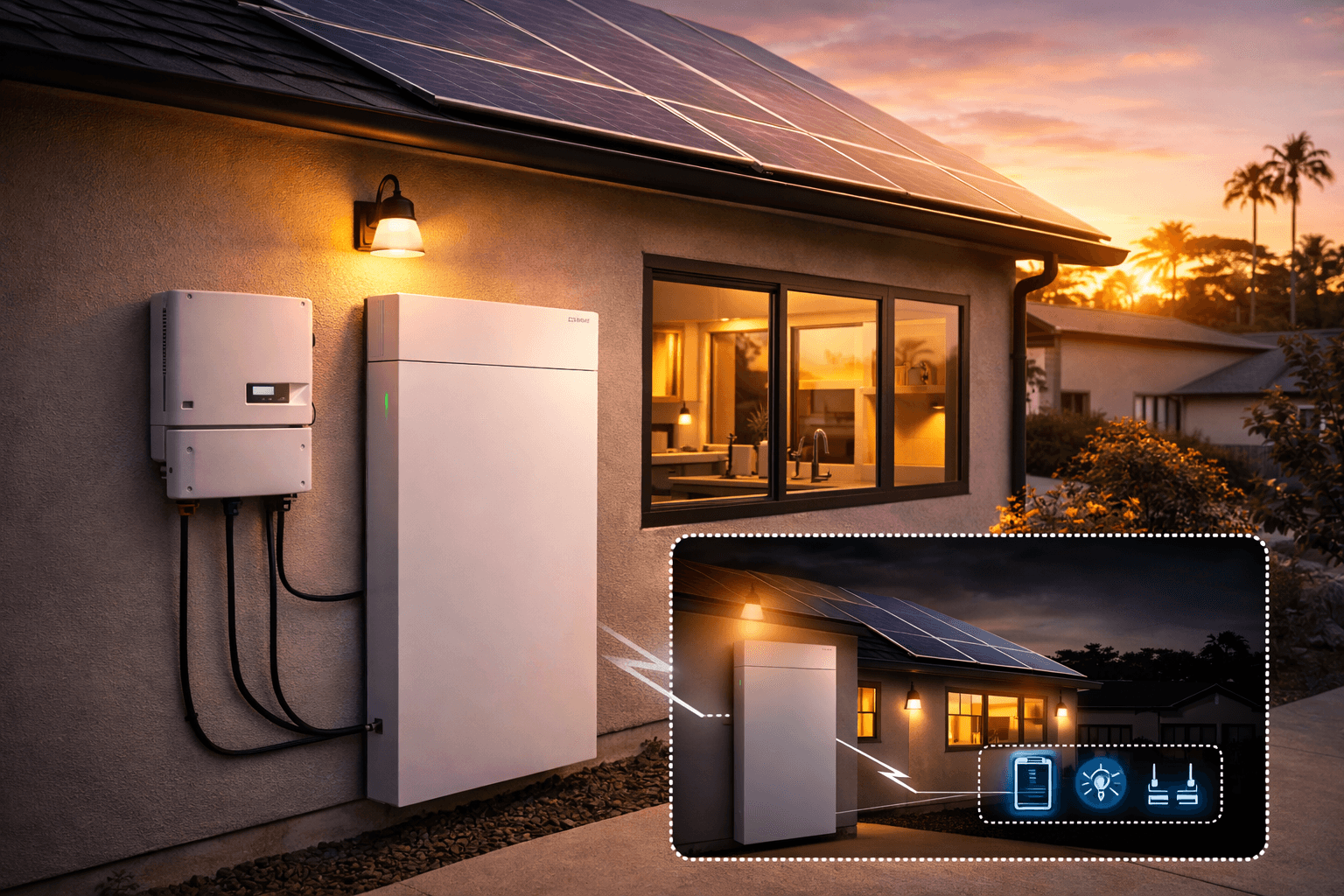
A battery changes everything. A well-sized home battery — whether a Franklin WH, Enphase IQ Battery, or SolarEdge system — captures the solar energy your panels produce during the day that your home cannot use in real time, and dispatches it in the evening when you would otherwise be drawing from the grid at peak rates. Under SCE's time-of-use pricing, evening demand hours are priced at a premium on top of the already-high base rate. Every kilowatt-hour your battery stores and dispatches at 5:00 p.m. saves you the full retail import charge rather than earning you 4–8 cents on an export.
For SCE customers, EnergySage estimates adding a battery delivers roughly $33,300 in additional 20-year savings over a solar-only system, with the exact figure sensitive to household usage profile, time-of-use behavior, and system sizing. The direction is unambiguous: under NEM 3.0, battery storage is not an optional upgrade — it is where the ROI lives. Learn more about battery options in our solar battery installation guide for Los Angeles.
Solar-Only vs. Solar + Battery: Payback Comparison
Scenario | Approx. System Cost | Payback (est.) | Notes |
|---|---|---|---|
Solar-only, LA (post-ITC) | ~$23,917 | 6.15 years | EnergySage marketplace data, May 2026 |
Solar-only, CA statewide (post-ITC) | ~$21,644 | 7.23 years | EnergySage marketplace data, May 2026 |
Solar + battery, SCE territory (post-ITC) | ~$40,000–$45,000 | 8–11 years (est.) | Based on PV Magazine NEM 3.0 industry data; treat as directional estimate |
The solar-plus-storage payback is longer in raw years — but the 25-year net position is substantially stronger, because you are avoiding peak-rate imports across the full lifetime of the system rather than exporting cheap energy and buying it back at full price. The goal is not to minimize payback period; it is to maximize the total dollars you keep instead of paying to the utility over 25 years.
One important operational note: the CPUC's own data shows approximately 70% of NBT customers paired battery storage with their solar system by end of 2024. The market has already voted with its money on this question.
Incentives That Survived: What Is Still on the Table in 2026
The ITC is gone. That does not mean the incentive landscape is empty. Several meaningful programs remain — some with deadlines that make them time-sensitive in ways that matter for 2026 decisions.
California Property Tax Exclusion — Deadline: January 1, 2027
California's active solar energy system property tax exclusion means that adding solar panels to your home does not trigger a reassessment or increase your property tax bill. This exclusion is not minor: on a $24,000 solar installation, the avoided annual property tax assessment could represent hundreds of dollars per year, compounding across the system's lifetime.
What most homeowners do not know: this exclusion is scheduled to sunset on January 1, 2027. SB 710 (2025 session) extended it through the current fiscal year, but systems must be completed before that sunset date to qualify. Anyone considering solar should factor this deadline into their timeline — it is one of the only remaining state-level incentives with a hard cutoff in the near term. Our California solar property tax exclusion guide covers the details of what qualifies and how to document it correctly.
NBT Export Rate Adder — Deadline: January 1, 2027
SCE, PG&E, and SDG&E customers who interconnect their solar system to the grid before January 1, 2027, lock in a nine-year enhanced export rate adder on top of the standard avoided-cost rate under NEM 3.0. The adder is not enormous in absolute terms, but over nine years, a consistent boost to your export credits adds up — and it costs nothing extra to qualify, other than completing your interconnection before the deadline.
As of May 2026, that deadline is less than eight months away. Interconnection applications require permitting, utility processing time, and inspection scheduling — in Los Angeles, that process can take 2–4 months under normal conditions. If you want to capture this adder, the time to start is now, not in the fall. See our solar panel installation service page for details on how we manage the interconnection process.
SGIP Battery Rebates
California's Self-Generation Incentive Program (SGIP) provides rebates for battery storage, but the landscape in 2026 is highly uneven depending on your income and utility status.
Equity and low-income customers in disadvantaged communities or on CARE/FERA rate plans can receive $1,000–$1,100 per kWh of storage capacity installed, plus $3,100/kW for solar. On a 10 kWh battery, that is $10,000–$11,000 in rebates. The Residential Solar and Storage Equity budget ($280 million) opened June 2, 2025, and this is where most available SGIP funding currently sits.
General market residential customers can receive $150 per kWh in SGIP rebates — but general market residential SGIP budget access is severely restricted in 2026, with most applicants facing waitlists. Do not plan your project budget around receiving general market SGIP funding without first verifying current availability through selfgenca.com.
If you are an equity-eligible customer, SGIP is a significant incentive that can materially change the battery ROI calculation. If you are not, treat it as a potential bonus rather than a baseline assumption. We have a full breakdown in our SGIP battery rebate guide for 2026.
Lease and PPA Options (TPO)
As noted above, homeowners who choose a lease or PPA may still benefit from the commercial ITC being passed through by their provider, though this window extends only into 2027–2028 depending on project specifics. If you are considering a TPO arrangement primarily for the credit benefit, get explicit written confirmation from the provider about what credit percentage they are claiming and what portion, if any, is reflected in your rate. The commercial ITC is also subject to FEOC manufacturing content rules that may affect equipment options.
"Customers can lock in current export rates by getting your solar panel system interconnected before January 1, 2027."
— EnergySage, California Solar Incentives 2026
What This Means for You
Here is a straightforward summary of where things stand for a Southern California homeowner evaluating solar in May 2026.
The federal tax credit is gone for purchased systems, and there is no legislative fix on the horizon. That is real. It adds roughly 2.2 years to your payback period compared to what it would have been under prior law. You should factor that into your expectations honestly.
At the same time, the case for solar in California remains strong — arguably stronger on a long-term basis than ever — because the rate environment keeps deteriorating. SCE at 34.5 cents per kWh, with continued CPUC-authorized increases scheduled through 2028, is the alternative. Every year you delay going solar is a year you spend at the mercy of those increases, with no hedge. The 25-year savings projections from EnergySage — $133,000–$176,000 depending on your location — reflect those rate increases compounding over time. They are not static estimates.
The bigger shift is this: under NEM 3.0, the solar system that made sense in 2021 is not the solar system that makes sense in 2026. A system sized to maximize export was fine when you were credited at retail. Today, the system that makes sense is one sized to maximize self-consumption, paired with battery storage that captures midday generation and dispatches it during evening peak hours. That is a more expensive upfront investment — solar plus storage runs $40,000–$45,000 for a typical SoCal system. The payback period is longer, in the range of 8–11 years depending on usage profile and SGIP eligibility. But the 25-year net position is substantially stronger than solar-only under NEM 3.0.
Two deadlines matter right now, and both expire before January 1, 2027: the California property tax exclusion and the NBT export rate adder for interconnections. If you are going to go solar, these are real reasons not to wait until next year.
LADWP customers in Eagle Rock, Highland Park, and surrounding neighborhoods have an additional reason to act: full retail-rate net metering under LADWP's rules means the solar economics are even more favorable than what SCE customers face. If you are in LADWP territory, the ITC expiration hurts less in relative terms because the ongoing export value per kilowatt-hour is so much higher.
Anca Solar is a licensed California solar contractor (CSLB #873768) based at 4519 Westdale Ave in Eagle Rock. We serve homeowners across Los Angeles County and work with SCE, LADWP, and other utility territories. Our job is to give you a straight answer about whether solar makes sense for your home and your numbers — not to sell you a system that doesn't pencil out, and not to oversell a situation that has genuinely gotten more complicated.
If you want us to run the actual math for your home — your utility, your usage, your roof — that starts with a conversation. Schedule a free solar consultation with Anca Solar and we will tell you exactly where your numbers land, including realistic payback projections that account for the post-ITC reality, NEM 3.0, and whatever incentives you qualify for.
Or if you are still in the research phase, start with our solar consultation overview to understand what that process looks like before you commit to anything.
Subscribe to our newsletter
Sign up to get the most recent blog articles in your email every week.