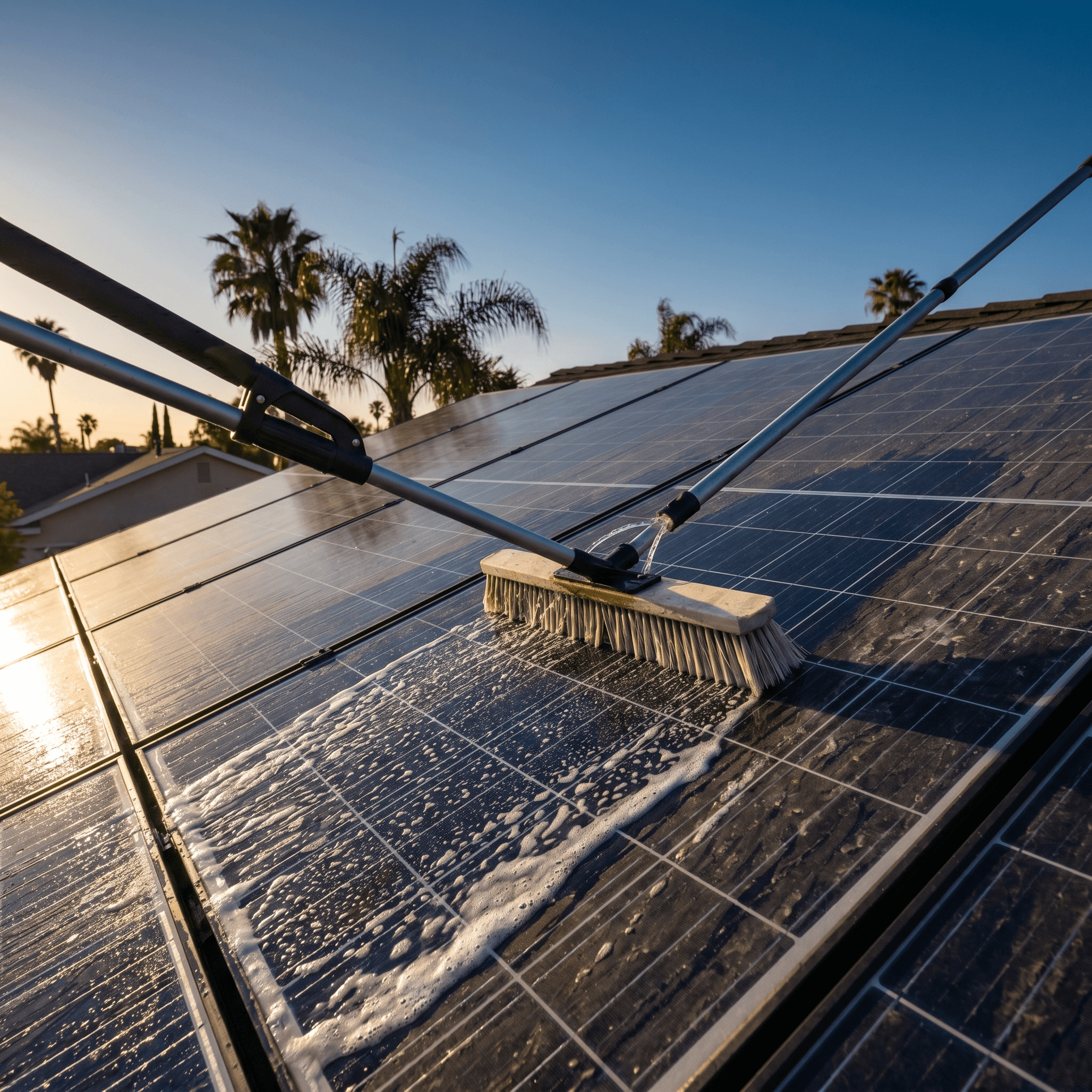
If you have solar panels on your roof in Southern California, solar panel cleaning may not be the first maintenance task that comes to mind — but six consecutive months without meaningful rainfall, Santa Ana winds carrying Mojave Desert dust across the basin, and wildfire seasons that leave acidic ash on every outdoor surface create one of the most demanding soiling environments for rooftop PV anywhere in the country. This guide is for SoCal homeowners who want an honest answer about how often to clean, how to catch soiling losses in their monitoring app before they compound, and whether hiring a professional is worth the cost.
According to EnergySage's research, homeowners who clean severely soiled panels typically see a 10–25% jump in energy production after a single service. For a typical 8 kW system in Los Angeles generating around 12,000 kWh per year, that is 1,200 to 3,000 kWh of production sitting uncaptured on your roof. At SCE's current average residential rate of 34.5¢/kWh (per SCE's own rate advisory, January 2026), that translates to $415 to $1,035 in electricity value per year.
How often you should clean solar panels in Southern California
The honest answer depends on where you live and what your panels have been exposed to. Southern California spans at least three distinct solar environments within 50 miles of each other, and each accumulates soiling at a different rate. The constant across all zones is the dry season: from roughly May through October, the LA Basin averages less than 0.2 inches of rainfall per month. Your panels go without natural cleaning for up to 150 days straight.
A note on the underlying data: The most recent published California-specific soiling rate in the scientific literature is approximately 0.05% per day of overall efficiency loss — from UC Davis research, from 2013. That is the most recent published California-specific rate, and no updated dataset covering the post-2017 drought intensification and changed wildfire pattern exists in the public literature as of this writing. We flag this data gap rather than substitute a figure. What we can say from our own field work across Eagle Rock, Pasadena, and the San Gabriel Valley: panels in the inland valley zone consistently show soiling-related production declines that justify at least two professional cleanings per year, and often more.
Cleaning frequency by zone
Based on Anca Solar's field experience across Los Angeles, Orange, and Ventura Counties, we use a three-zone framework when advising customers on cleaning schedules:
Coastal zone (Santa Monica, Long Beach, Torrance, Huntington Beach, Newport Beach): Salt air deposits build on panel glass year-round — not just during dry season — and marine layer moisture concentrates particulates on the panel surface as it evaporates. We recommend three cleanings per year: late April or early May once the rainy season ends, August at the dry-season midpoint, and October before Santa Ana season peaks. No peer-reviewed study has directly compared coastal versus inland SoCal soiling rates within the past two years; this schedule reflects our field observations and the well-established principle that salt-air environments accelerate surface contamination on glass.
Inland valleys (Eagle Rock, Pasadena, Arcadia, Pomona, Anaheim, Irvine, Orange): The primary soiling sources here are construction dust, vehicular exhaust, and Santa Ana wind-carried Mojave Desert particulate. This zone was also directly in the path of ash fallout from the January 2025 Eaton Fire — panels across Altadena, Eagle Rock, and Pasadena received significant deposits. We recommend a minimum of two cleanings per year — late April or early May, plus October or early November — with additional unscheduled service after any significant wildfire ash event. If you are a Pasadena Water and Power customer thinking about pairing a battery storage system with your next service visit, see our post on PWP's 2026 solar and battery rebate program for the current incentive details.
High-desert-adjacent zones (Simi Valley, Moorpark, Camarillo, areas near the 14 Freeway corridor): Highest baseline dust load, closest to Mojave air masses, lowest rainfall. Panels in these areas can accumulate visible soiling within weeks during dry periods. We recommend three to four cleanings per year — roughly quarterly during the dry season — plus emergency service after any significant ash or Santa Ana event.
Event triggers — clean within 7 to 14 days regardless of your schedule
Wildfire ash fallout. Ash particles are acidic and can etch anti-reflective panel coatings during daily heat cycling. Do not let ash sit through more than one or two heat cycles before scheduling a wash. More on the January 2025 events and why ash is treated as an emergency trigger in the wildfire section below.
Santa Ana wind events. Each major Santa Ana can deposit the equivalent of weeks of baseline soiling in hours. Do a visual check from the ground within 48 hours of any event, and schedule cleaning within two weeks if heavy dust deposits are visible.
Active construction nearby. A neighbor adding a second story, or a commercial development within a block, dramatically elevates ambient dust. Consider monthly monitoring app checks rather than quarterly during active construction phases.
Concentrated bird or wildlife droppings. Droppings cause localized shading that monitoring will catch as sharp per-module underperformance — not the gradual slope of dust soiling. Spot-clean affected panels rather than waiting for a full-system service date. Our guide to panel lifespan and degradation monitoring explains how to tell these signatures apart in your app.
How to detect soiling losses from your monitoring app
The most reliable way to know when your panels actually need cleaning — rather than guessing from a calendar — is to learn the soiling signature in your monitoring data. Most SoCal residential systems run either Enphase Enlighten or a SolarEdge monitoring portal. Neither platform has a built-in soiling alert as of 2026, but soiling has a distinct signature that a five-minute monthly check can surface.
The core method is weather-adjusted year-over-year comparison. Pull up the same week in the prior year in your monitoring app. If your system is producing 10% or more below that prior-year week — and there is no obvious weather explanation such as extended cloud cover or a new shading source — soiling is the first thing to investigate. Routine seasonal soiling shows as a gradual slope downward across the dry-season months. An acute event like a Santa Ana or wildfire shows as a sharp one- or two-day drop followed by a new, lower baseline.
Platform-specific tips
Enphase Enlighten:
Go to Production tab → Lifetime view and look for a gradual downward trend in annual production that does not track with local weather patterns.
Use the Energy vs. Power view comparison on clear days to separate irradiance-related variation from panel-level efficiency decline. If peak Power output on clear days is also declining, that points to a panel-level issue — soiling, soiling-induced hot spots, or early degradation.
Enlighten detects microinverter faults — it does not alert on gradual soiling. Set a monthly calendar reminder to compare the current week to the same week one year ago. Do not wait for an alert that will not come.
SolarEdge monitoring:
SolarEdge HD-Wave inverters provide module-level power data. Within any string, modules should produce within a few percentage points of each other on a clear day. If one or two modules consistently underperform their string neighbors by 10% or more, that points to localized soiling — most often bird droppings or windblown debris — rather than whole-system dust accumulation.
For whole-system soiling, use the same year-over-year comparison: compare equivalent clear-day production periods across years. A 1–2% monthly production decline over five or six consecutive dry-season months is a recognizable soiling signature — distinct from the 0.3–0.5% annual degradation rate expected from normal panel aging.
"If your monitoring shows more than 10% unexplained production loss against equivalent solar conditions from a year ago, investigate soiling before you schedule a technical service visit. A meaningful share of service calls attributed to equipment faults turn out to be dirty panels."
This general rule — investigate soiling first for any gradual production decline, before assuming equipment failure — reflects standard practice in professional O&M (operations and maintenance) work across the commercial solar sector, applied here to residential systems. There is no Enphase or SolarEdge published threshold we can cite for residential soiling detection; the above reflects industry practice and our own field experience with systems across LA, Orange, and Ventura Counties.
DIY vs. professional cleaning: the trade-offs we walk through with customers
We get this question from nearly every customer who schedules a solar maintenance visit with us. The short answer: DIY cleaning is appropriate for single-story homes with accessible panels, routine dust soiling (not ash), and the right equipment. Professional cleaning makes more sense for rooftop systems with significant pitch, second-story installations, or any post-wildfire ash cleaning where debris composition may include hazardous materials.
Safety is the primary argument for professional service on rooftop systems. Falls from roofs are a leading cause of residential construction fatalities, and wet panels on a pitched roof are slippery. If your panels are on a second story or on a roof pitch greater than 4:12, the fall risk from DIY cleaning is not offset by any cost savings. On ground-mounted systems, DIY is considerably lower risk.
Water quality matters more than most homeowners expect. Hard water — common throughout the LA Basin and San Gabriel Valley — leaves calcium and mineral deposits on panel glass when it evaporates. Cleaning with unfiltered tap water can leave a mineral film that reduces light transmission and is harder to remove than ordinary dust. Professional services use deionized or purified water; if you clean yourself, use purified or distilled water with a soft brush and no detergent unless specifically approved by your panel manufacturer.
Equipment choices affect your warranty. Per EnergySage's cleaning research: "Scratching or damaging the glass in any way will reduce a panel's energy production — much more than any removable soot or dust buildup will — and potentially void your warranty." High-pressure washers, abrasive scrub pads, and strong detergents are the most common DIY mistakes that lead to permanent surface damage. Both REC and Silfab publish manufacturer-specific cleaning guidelines in their product documentation; check your panel manufacturer before adding any cleaning solution.
Post-wildfire ash is a special case — we recommend against DIY. Ash from urban structure fires can contain materials very different from clean wood ash — including residues from burned electronics, paints, and treated lumber — and disturbing heavy deposits without proper protective equipment and runoff containment is a genuine health and environmental risk. For any post-wildfire cleaning, professional service is the right call.
What professional cleaning typically costs — and how to think about ROI
No published, LA Basin-specific professional cleaning price survey from the past two years exists that we can responsibly cite. From our interactions with the market: professional residential solar cleaning in greater Los Angeles typically runs in the range of $150–$350 per visit for a standard 20- to 24-panel rooftop system, depending on roof pitch, panel count, accessibility, and whether deionized water equipment is required. Annual maintenance contracts — two cleanings per year plus a visual inspection — often come in below the cost of two separate visits booked individually.
The ROI math at current rates: at 34.5¢/kWh (SCE January 2026 average), recovering 1,200 kWh of lost annual production — 10% of a 12,000 kWh/year system — is worth roughly $414 per year. Two professional cleanings at $200 each is $400. On an inland valley system with meaningful soiling accumulation, that is a near-breakeven or net-positive maintenance investment. On a coastal system with lighter soiling, the economics are tighter. The right answer for your home is to look at your own monitoring data and see what your actual dry-season production loss looks like year over year before committing to any service schedule. If you want a second opinion on your system's current performance, our process page explains how we approach maintenance evaluations for existing systems — reach out to schedule a free consultation.
Wildfire ash and Santa Ana winds: the SoCal-specific cases
Most national solar cleaning guides treat wildfire ash and wind events as edge cases. In Southern California in 2025 and 2026, they are routine. The January 2025 LA wildfires brought this into focus for every solar owner in our service territory: the Eaton Fire burned 14,021 acres through Altadena and the foothills above Pasadena; the Palisades Fire burned 23,448 acres on the West Side — both figures from CAL FIRE's 2025 incident archive. The LA Times reported ash blanketing communities across the San Gabriel Valley. AirNow monitoring data documented PM2.5 at hazardous levels at multiple LA Basin stations throughout the event.
We saw the production impact directly in monitoring data from our customers in Eagle Rock, Altadena, and Pasadena in the days following those fires. Production drops in the immediate aftermath of major ash events are visible in monitoring records as an acute, steep decline — distinct from the gradual slope of routine seasonal soiling. We have observed this pattern with multiple customers in our service area after the January 2025 fires, and it is consistent with what any SoCal solar owner should expect after a major ash event affecting their neighborhood.
What makes wildfire ash more urgent than routine dust is the chemistry. Ash is alkaline and hygroscopic — it absorbs atmospheric moisture and can form a mildly caustic paste on panel glass during morning dew and daily heat cycling. Over multiple days, repeated wet-dry cycles can begin to etch anti-reflective coatings in ways that a simple rinse will not fully reverse. The 7-to-14-day service window after a significant ash event is not arbitrary; it reflects the practical timeline before repeated heat cycles compound the risk of permanent coating degradation.
Santa Ana winds create a separate but related challenge. California experiences roughly 10 to 25 of these events per year, primarily in autumn through early spring, with sustained winds that routinely exceed 40 mph and carry fine mineral dust from the Mojave and Great Basin across the coastal basin — sometimes overnight. The January 2025 events reached sustained gusts above 80 mph at some inland mountain pass stations, per National Weather Service Los Angeles records. A single major event can deposit weeks of baseline soiling on your panels in a matter of hours.
The practical post-event protocol:
After any wildfire where ash fallout is visible in your area: schedule professional cleaning within 7–14 days. If public health guidance has flagged potential hazardous materials in the ash, do not attempt DIY cleanup without appropriate protective equipment.
After a Santa Ana event with sustained winds above 40 mph: do a visual check from the ground within 48 hours. If heavy dust deposits are visible, check your monitoring for a production dip on the next clear day and schedule cleaning within two weeks.
After both events in close succession: treat it as an immediate service trigger and check your monitoring on the first clear day after conditions settle.
What this means for you
Southern California's combination of a six-month dry season, 10 to 25 annual Santa Ana events, and a wildfire risk that reaches directly into residential neighborhoods makes panel maintenance more consequential here than in most of the country. A well-maintained cleaning schedule, combined with monthly monitoring app reviews, is the highest-return, lowest-cost maintenance action available to any SoCal solar owner. We have watched dust and ash quietly erode customer production for years — and watched the same systems jump back to full output the day after a thorough cleaning. That is the data point that matters for your bill.
At Anca Solar, we work with homeowners across Los Angeles, Orange, and Ventura Counties on both new solar panel installations and keeping existing systems at rated output. If you are not sure whether your system is performing as it should — or if you would like help setting up a maintenance schedule that accounts for your specific zone, panel configuration, and monitoring platform — we can help. Schedule a free solar consultation with Anca Solar. We have been serving LA homeowners for more than 25 years and we hold the licenses and experience to handle everything from routine maintenance guidance to full system inspections. Learn more about our team and how we work before you commit to anything. (CSLB License #873768.)
Subscribe to our newsletter
Sign up to get the most recent blog articles in your email every week.