When we do a solar installation in Los Angeles, the inverter question comes up on almost every roof walk. Homeowners have done their research — they know there are two main camps — but they want to understand what actually matters for a Spanish tile roof on a hillside lot in Eagle Rock, or a two-story Craftsman in Pasadena with a palm tree twenty feet off the south edge. This guide answers that question with the specifics SoCal homeowners need in 2026.
The short version: microinverters win on most LA-area roofs. But the reasoning behind that matters as much as the conclusion — because there are real scenarios where a string inverter with power optimizers is the right call, and we'll tell you exactly what those are.
How Each Technology Works — and Why the Difference Matters on Your Roof
Both microinverters and string inverters do the same fundamental job: they convert the DC electricity your solar panels produce into the AC power your home uses. The difference is where and how that conversion happens — and that architectural choice has downstream effects on shading, safety, battery storage, and long-term maintenance that show up clearly in the LA housing stock.
String inverters: the central hub model
In a conventional string inverter system, your solar panels are wired together in series — a "string." That string carries high-voltage DC current down from the roof, through the conduit, to a single inverter typically mounted in the garage or on an exterior wall. The inverter does all the conversion work for the entire array.
The critical limitation: the string's output is governed by its weakest panel. If one panel is shaded, soiled, or degraded, the entire string's production can drop to match it — like a chain only being as strong as its weakest link. Modern string inverter systems address this by pairing a power optimizer on every panel. SolarEdge's optimizer lineup, for example, gives each panel its own maximum power point tracking (MPPT), so a shaded panel no longer drags down its neighbors. Per SolarEdge's product documentation, the optimizer is designed to "maximize the energy production of each solar panel and mitigate mismatch loss, from manufacturing tolerance to partial shading and aging."
The string inverter itself, though, remains a central point of failure. If it goes down, the entire system goes offline — both solar production and any backup power capability — until the inverter is serviced.
Microinverters: the distributed model
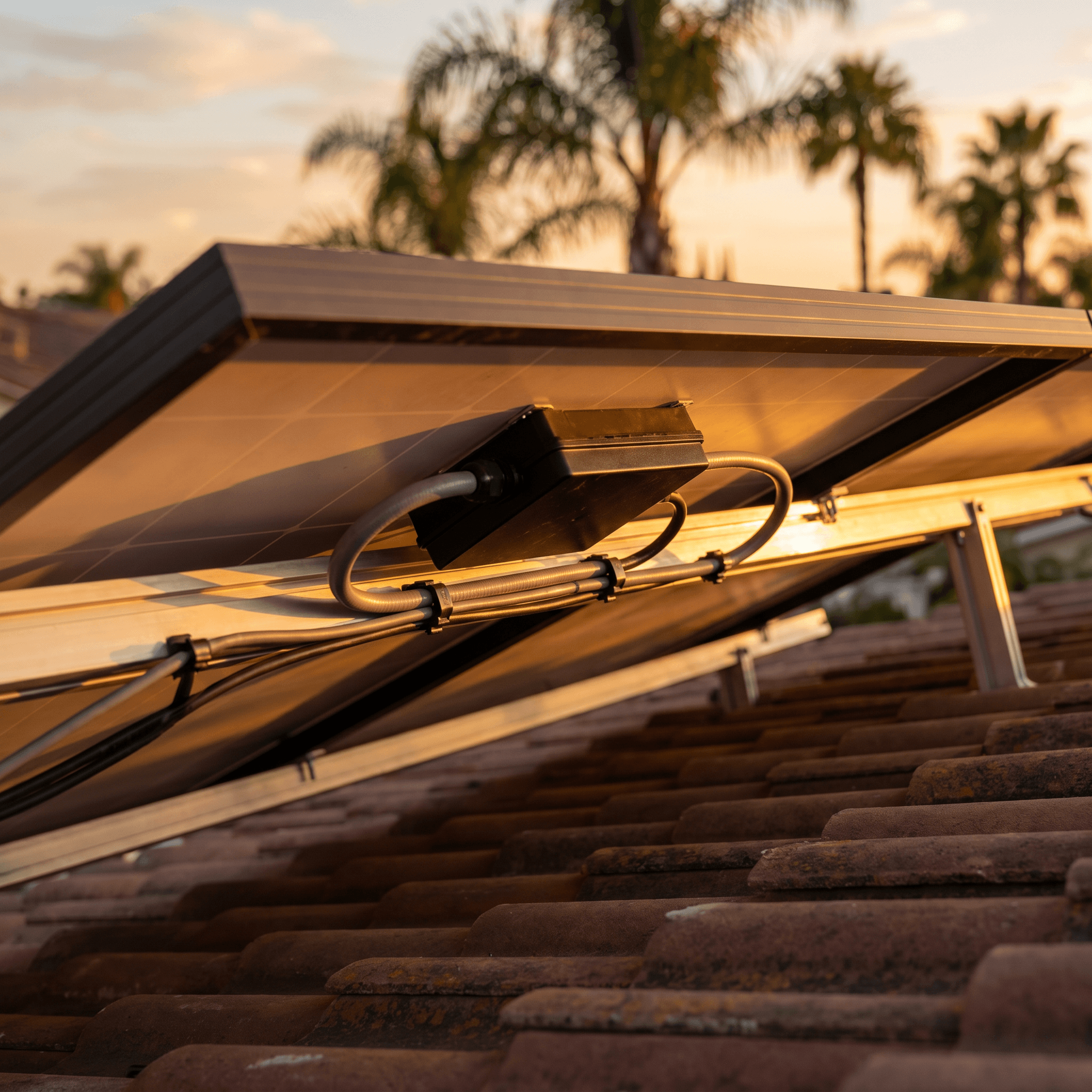
A microinverter system puts a small inverter on the back of every individual panel. Each panel converts its own DC output to AC right at the module — no high-voltage DC runs through your roof structure, conduit, or attic. As Enphase describes the IQ8 architecture, systems "Never contain high-voltage DC power," operating at "the same low-voltage AC power as a typical home."
The practical results for a SoCal roof: fault isolation (a shaded or failed panel affects only that panel), no single central point of failure, and module-level monitoring. Per Solar Power World's February 2026 analysis, modern inverters have become "power management platforms" — and microinverters carry this to the individual panel level, making it possible to detect a single underperforming unit from your phone before it compounds into weeks of lost production.
Power optimizers: the hybrid middle ground
SolarEdge's string inverter + power optimizer system occupies a middle position. You get per-panel MPPT (similar in performance to microinverters for most shading scenarios), module-level monitoring through the mySolarEdge app, and SolarEdge's SafeDC rapid-shutdown system that "automatically reduce[s] voltage in each panel to touch-safe levels upon inverter shutdown." The central string inverter still handles final DC-to-AC conversion — meaning the single-point-of-failure dynamic remains, but shading performance is substantially improved over a basic string inverter without optimizers.
"The architecture question isn't which technology produces more power on a perfect sunny day in July. It's which technology protects your investment when the roof isn't perfect — which is most roofs in Los Angeles."
Shade Tolerance: The Reason Most LA-Area Homeowners Choose Microinverters
Southern California looks sun-drenched on paper. But LA rooftops are a different story. Between palm trees, two-story neighbor additions, chimneys on pre-1960 homes, and the complex hip-and-valley roof geometry common in the San Gabriel Valley and Northeast LA, most of the roofs we assess have at least one shading factor that a satellite shade model doesn't capture accurately.
That uncertainty has a documented cost. According to Solar Power World's September 2024 analysis of shade modeling methodology, around one-third of arrays modeled with satellite imagery had a greater than 10% delta between estimated and actual production. A 10% production shortfall on a 10 kW system is 1,000+ kWh per year — roughly $200–$400 in missed bill credits under SCE's current rate structure.
The palm tree problem
Palm fronds create narrow, intermittent shade that moves with the wind and sweeps across multiple panels at different times of day. This is one of the worst shading patterns for a conventional string inverter without optimizers, because the weak link in the string changes constantly throughout the day. With microinverters, each panel responds independently to whatever light it receives at that moment — the panel under a moving frond shadow produces what it can, and the panels in full sun continue uninterrupted.
With a string inverter plus power optimizers, you get similar individual-panel response. Where microinverters maintain a structural advantage is under truly dynamic, unpredictable shade: there is no central inverter to develop partial-load stress from constant MPPT fluctuation, and no single component whose failure takes the whole system offline during a multi-week repair wait.
When a string inverter with optimizers is genuinely fine
We don't want to oversell microinverters where they don't earn their price premium. If your roof is a simple south-facing plane — no dormers, no chimneys, no trees within 30 feet, no neighbor additions casting shadows — a SolarEdge HD-Wave string inverter with power optimizers performs comparably to a microinverter system in day-to-day production. Per Solar Power World's July 2024 technical analysis, panel-level electronics "lessen the impact of events such as shading," and both microinverter and optimizer architectures achieve this effectively on straightforward roofs.
The calculus changes if you're adding a battery, prioritizing backup resilience, or dealing with any of the tile-roof access issues we'll cover below. But on an uncomplicated roof where the goal is pure production optimization, the optimizer stack is a legitimate choice — and it typically carries a more modest upfront cost.
California Fire Code, Rapid Shutdown, and What Your Roof Actually Requires
California's building code requires rapid shutdown capability on rooftop solar systems under NEC 690.12. This provision exists so that firefighters responding to a structure fire can de-energize a solar array quickly — reducing the risk of electrocution from energized panels or wiring while crews work on the roof or in the attic. If you're evaluating inverter options in 2026, understanding how each technology satisfies this requirement matters both for permit compliance and for installation cost.
How microinverters comply — inherently
Enphase IQ8 microinverters satisfy NEC 690.12 by design. Because DC power is converted to AC at each panel's backsheet, there is no high-voltage DC pathway through the roof structure or conduit at any point. Per Enphase's product documentation, the IQ8 provides "built-in rapid shutdown to help keep utility workers and first responders safe." When the main service disconnect is opened, all microinverters de-energize within seconds. No additional rapid-shutdown transmitter, no module-level device, no separate hardware — the compliance is structural to the architecture.
This has a real-world installation cost benefit: it simplifies the permit package, reduces component count, and eliminates one category of field hardware that can fail or require future servicing.
How SolarEdge string systems comply — via SafeDC
SolarEdge achieves NEC 690.12 compliance through its SafeDC system embedded in every power optimizer. SafeDC "automatically reduce[s] voltage in each panel to touch-safe levels upon inverter shutdown," bringing DC voltage down to less than 1 volt per module within 30 seconds of grid loss. This satisfies the module-level rapid shutdown requirement under NEC 690.12 Section 2. The key requirement: every panel in the array must have a power optimizer installed. A basic string inverter without optimizers does not satisfy California's rapid shutdown requirement and will not pass permit inspection.
The practical implication: if you're comparing a string inverter quote that doesn't include power optimizers on every panel, that quote is not code-compliant for a California installation. Make sure you're comparing complete, permit-ready systems when evaluating costs.
An industry survey published by pv magazine USA in January 2026 reported that firefighters broadly prefer microinverter-based solar systems because they "integrate rapid shutdown at the panel level" without "additional external components." Worth noting: that survey was led by a paid Enphase consultant, so it reflects the industry's perspective with a disclosure attached — but the underlying NEC compliance principle is accurate regardless of who funded the survey. Enphase has shipped approximately 84.8 million microinverters globally, with more than 5 million systems deployed across 160+ countries (per pv magazine USA, January 2026).
NEM 3.0, Battery Storage, and How Your Inverter Choice Affects Self-Consumption
California's Net Billing Tariff (NBT) replaced NEM 2.0 effective April 15, 2023, per CPUC Decision D.22-12-056. Under NBT, daytime solar export rates are significantly lower than retail electricity rates — the economics shift from "export as much as possible" to "use as much as possible yourself." The CPUC reports that nearly 70% of NBT customers who installed through end of 2024 paired batteries with their solar. Battery storage is how NEM 3.0 customers store daytime solar production and shift it to high-value evening hours. Your inverter choice and battery choice are therefore interconnected — for a deeper look at how to think about that pairing, see our guide to solar and battery storage under NEM 3.0 in Southern California.
AC-coupled microinverter systems: flexible, scalable, blackout-ready
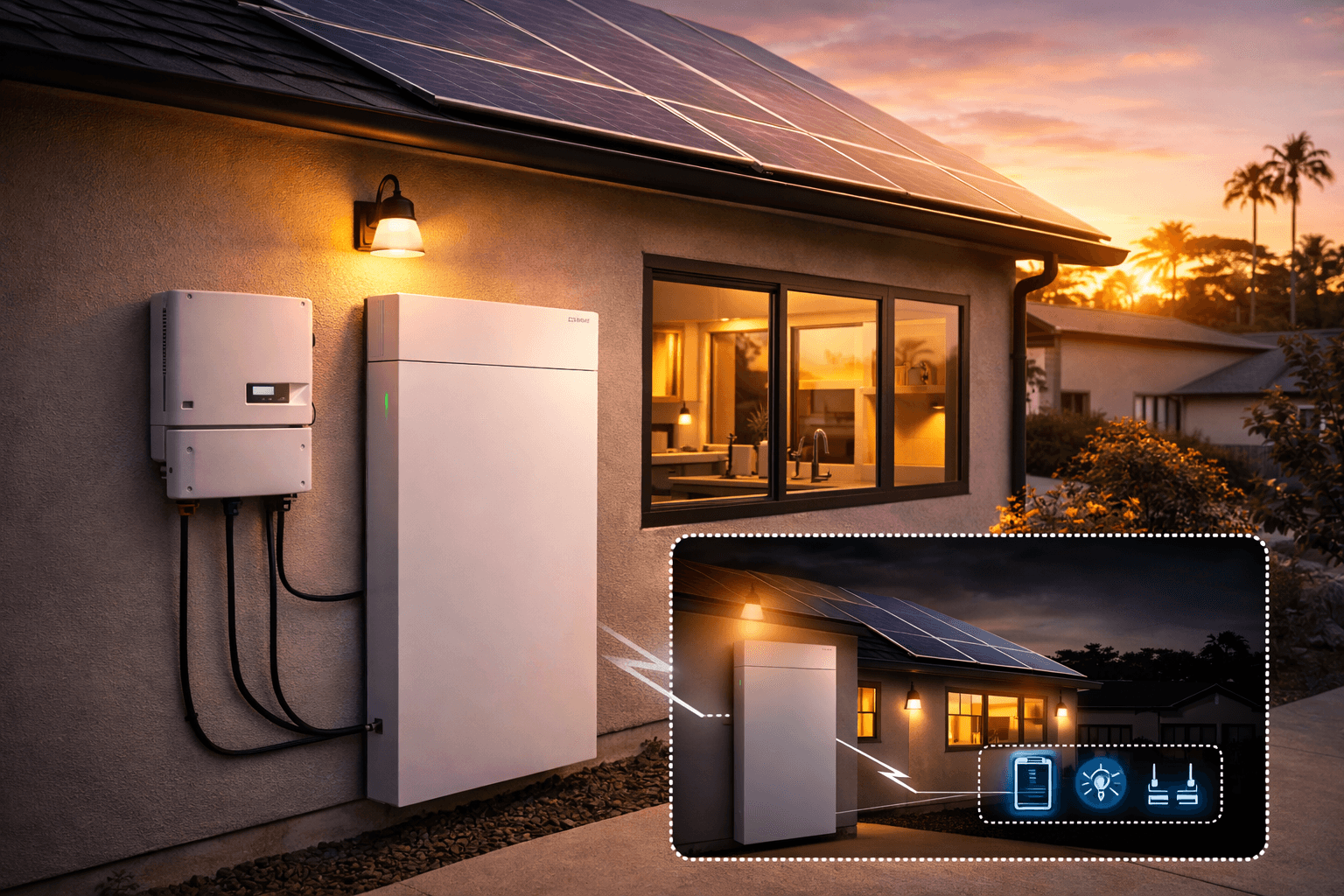
An Enphase IQ8 system pairs naturally with the Enphase IQ Battery 5P in an AC-coupled architecture. The battery charges from the microinverters' AC output or from the grid during low-rate hours, and it dispatches stored energy to home loads or the grid during peak evening hours. The system scales in 5 kWh increments up to 40 kWh — add batteries as your EV or electrification needs grow without redesigning the DC architecture.
Two IQ8 capabilities matter specifically in SoCal. Sunlight Backup lets the system power home loads directly from solar during a grid outage, even without a battery present — something string inverters cannot do without a specific backup-capable inverter SKU. Sunlight JumpStart, per Solar Power World's October 2025 coverage, enables the system to "automatically recharge and restore power when [the] microgrid collapses due to depleted batteries" — meaning a multi-day PSPS event that drains the battery doesn't leave you without any coverage once the sun rises.
DC-coupled string systems: efficient, but a single point of failure
The SolarEdge Home Hub + SolarEdge Home Battery uses DC coupling, with the battery connecting directly to the DC bus before the inverter. This is slightly more efficient on paper for daily charge/discharge cycles, and it's a legitimate choice on a simple, unshaded, high-production roof where efficiency optimization outweighs resilience concerns. The key tradeoff: if the central inverter fails, both solar production and battery backup go offline simultaneously until service arrives. Not every SolarEdge string inverter SKU provides backup capability either — confirm the specific model in writing before signing. For the battery storage options we install across Los Angeles, both architectures are available — we size and specify based on the roof and the homeowner's priorities.
Tile Roofs and Long-Term Access: A SoCal-Specific Consideration
Most homeowners in Eagle Rock, Pasadena, Glendale, and Burbank are sitting under a clay or concrete tile roof built before 1990. For a deeper look at tile-specific installation logistics, our concrete tile roof solar installation guide covers the full process. For inverter selection specifically, tile creates two dynamics worth understanding.
First, heat. Solar equipment under a tile array runs hotter than on open-rack or composition-shingle installations. Both microinverters and power optimizers are rated for these conditions — the Enphase IQ8 carries a NEMA 6 rating (weatherproof, submersion-certified, heat-hardened) — but adequate airflow spacing during mounting matters on any tile roof.
Second, access. On a clay tile roof, replacing any component under a panel requires lifting tiles — adding cost and roofing subcontractor coordination to every service call. Module-level monitoring via the Enphase Enlighten app lets a tile-roof homeowner identify and track a specific underperforming panel remotely, deferring the physical service visit until it's clearly warranted rather than sending a crew onto a fragile tile surface for every performance question. A string inverter provides string-level data only; a single faulty panel may take weeks to register as a visible deviation. The string inverter's central unit, at least, is mounted on a garage wall — accessible without any roof work — though power optimizers on a tile roof still require tile access if they ever need replacement.
Side-by-Side Comparison: Enphase IQ8 vs SolarEdge HD-Wave + Optimizers
The table below reflects the architectures as we install and service them in the field across LA, Orange, and Ventura Counties. Where a specification was not confirmed directly from manufacturer documentation during research for this post, we've noted that rather than citing an unverified figure.
Feature | Enphase IQ8 (Microinverter) | SolarEdge HD-Wave + Power Optimizers (String) |
|---|---|---|
Architecture | One inverter per panel; all AC from module to panel | Central string inverter + per-panel DC optimizer |
Rapid shutdown (NEC 690.12) | Built-in; no additional hardware required | Via SafeDC in every power optimizer |
DC voltage on roof/conduit | None — converted to AC at each panel | Present until SafeDC activates; reduces to touch-safe in shutdown |
System failure mode | Single panel offline if one unit fails | Entire system offline if central inverter fails |
Shade tolerance | Per-panel MPPT — each panel independent | Per-panel MPPT via optimizer — each panel independent |
Sunlight backup without battery | Yes (IQ8 grid-forming ASIC) | Only with specific Home Hub SKU |
Battery coupling | AC-coupled (IQ Battery 5P) | DC-coupled (Home Battery) |
Battery scalability | 5 kWh increments, up to 40 kWh | Less modular; DC architecture dependent |
Monitoring | Module-level (Enphase Enlighten app) | Module-level (mySolarEdge app, requires optimizer on every panel) |
Microinverter/optimizer warranty | 25 years (all IQ8 models) | 25 years (power optimizers, per model) |
Central inverter warranty | N/A (no central inverter) | Manufacturer terms — verify with installer |
Compatible module size | Up to 540W per panel (IQ8M) | S440 up to 490W; S500 up to 550W; S500B/S650B/S650A for high-voltage modules |
Upfront cost | Typically modestly higher | Generally lower for the inverter hardware alone |
Best fit | Complex roofs, shade risk, tile, backup priority, battery scalability | Simple south-facing roof, DC-coupled storage, efficiency-focused |
Warranty and Long-Term Cost: What the Numbers Mean
Solar panels typically carry 25-year product and performance warranties. Your inverter should match. Enphase's IQ8 microinverters carry what the company describes as an "industry-leading 25-year limited warranty" — the same timeframe as the panels they serve.
String inverters typically carry shorter standard warranties, with optional extensions available at added cost. We don't cite SolarEdge's current warranty term here because we were unable to confirm it directly from their documentation during research for this post — ask any installer for this figure in writing before signing. The practical implication: if the standard warranty period expires before your 25-year panel warranty does, you're budgeting a mid-life string inverter replacement. Including labor, equipment, and permit, that's a meaningful cost built into total system ownership — not just the upfront quote comparison.
On price, Solar Power World's April 2025 report on residential solar pricing put the national median quoted system price at $2.50 per watt — the lowest on record since EnergySage began tracking in 2014. Microinverter systems typically carry a modestly higher upfront cost than comparable string inverter systems, reflecting the additional hardware of one inverter per panel. Whether that premium is justified depends on your roof's shade complexity, backup priorities, and long-term ownership math. On most LA-area roofs we assess, it is.
"The question we ask on every roof walk is: what happens to this system when something goes wrong? On a microinverter system, something going wrong usually means one panel underperforms for a day until we get a notification. On a string inverter system, something going wrong can mean the whole system is down until a service crew arrives."
Which System Is Right for Your Roof?
After 25 years of installations across Eagle Rock, Pasadena, Glendale, Burbank, and the broader LA Basin, here is how we think through this on any given roof. Learn more about our approach and the markets we serve.
Choose microinverters (Enphase IQ8) if any of the following apply:
Your roof has any shading — trees, chimneys, dormers, or neighbor structures casting shadows during peak hours.
You have a clay or concrete tile roof and want module-level monitoring to minimize physical service visits.
You're pairing a battery and want to add capacity in 5 kWh increments without redesigning the DC architecture.
Backup resilience during PSPS events is a priority — including the Sunlight Backup capability that operates without a battery present.
You want inverter warranties that match your 25-year panel warranty with no mid-life replacement to plan for.
You have a multi-orientation roof where separate per-panel MPPT captures more production than a single string.
Consider a string inverter with power optimizers (SolarEdge) if all of the following apply:
Your roof is a simple, unshaded south-facing or southwest-facing plane with no meaningful shade source within 30 feet.
You're prioritizing DC-coupled battery efficiency over resilience and scalability.
You've confirmed in writing the warranty terms and backup capability of the specific inverter model quoted.
You've factored potential mid-life inverter replacement into the total cost comparison and the string system still makes sense for your situation.
Frequently Asked Questions
Can I mix microinverters and string inverters on the same roof? Generally no. The two systems use different wiring architectures and monitoring platforms. A single-technology approach with per-panel electronics handles both simple and complex roof sections cleanly.
Do microinverters work in LA's summer heat? Yes. The Enphase IQ8 carries a NEMA 6 rating (certified for high-temperature, high-humidity, and submersion conditions) and is built on advanced 55nm ASIC technology. Heat reduces panel output — as it does with all solar equipment — but the microinverter electronics are rated for California rooftop conditions.
Can I see individual panel output with a string inverter? With SolarEdge power optimizers on every panel, yes — the mySolarEdge app provides module-level data comparable to Enphase Enlighten. A basic string inverter without optimizers provides only string-level data; individual panel faults may go undetected for weeks. Any string inverter quote for a California installation should include optimizers on every panel for both NEC compliance and monitoring.
Does California code require rapid shutdown on my roof? Yes. NEC 690.12 applies to all California residential solar installations. Enphase microinverter systems satisfy it inherently by architecture; SolarEdge satisfies it via SafeDC in the power optimizers. A basic string inverter without module-level hardware will not pass an AHJ inspection in California.
Does my inverter choice affect NEM 3.0 bill savings? Indirectly, yes. NEM 3.0 rewards self-consumption over export, and both systems support time-of-use battery dispatch. The Enphase system's Sunlight Backup and Sunlight JumpStart features maximize self-consumption even through multi-day outages — a meaningful advantage in PSPS-prone hillside areas. SolarEdge DC coupling offers marginally higher charge/discharge efficiency on a straightforward roof.
Working with Anca Solar
We've installed solar across Eagle Rock, Pasadena, Glendale, Burbank, and throughout Los Angeles, Orange, and Ventura Counties for over 25 years. Every roof we assess gets a real shading analysis, a frank discussion of which technology fits the specific conditions, and a quote that reflects what the system will actually cost installed and permitted. We install both Enphase and SolarEdge systems — our recommendation comes from the roof, not from which product has a better margin.
If you're weighing microinverters versus string inverters for your home, we can help. Schedule a free solar consultation with Anca Solar — we'll walk your roof, assess the shading, and give you an honest side-by-side breakdown for your specific situation. We serve homes across LA, Orange, and Ventura Counties and bring 25+ years of installation experience to every project. (CSLB License #873768.)
Subscribe to our newsletter
Sign up to get the most recent blog articles in your email every week.