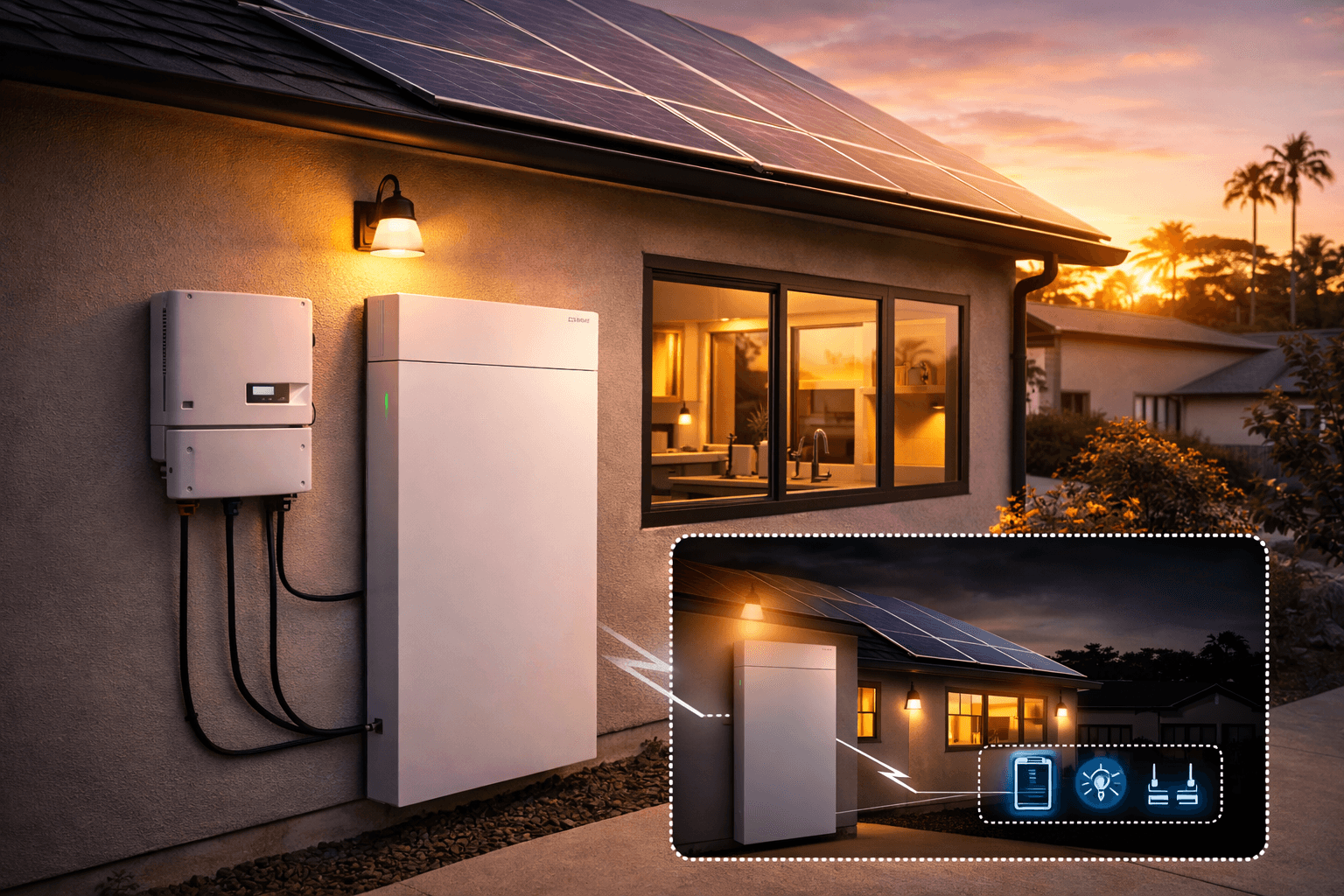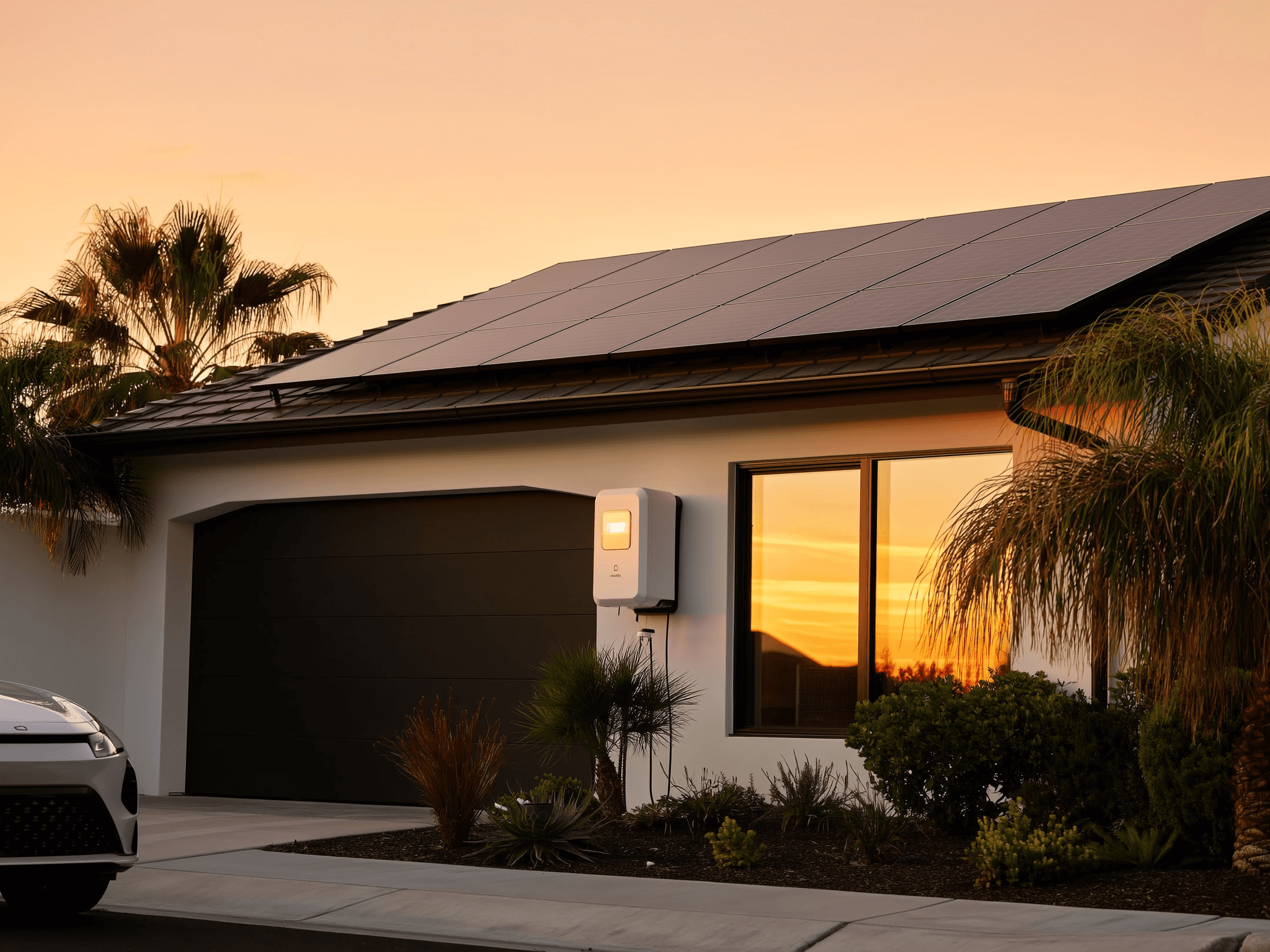
If you are evaluating the Enphase IQ Battery 5P for your Southern California home, this guide gives you everything you need to make a confident decision: the confirmed specifications, the NEM 3.0 financial case in plain math, SGIP eligibility status verified from the official equipment list, a head-to-head comparison against the Franklin WH aPower2, and what to expect from installation. This is written for homeowners who either already have Enphase solar and are considering adding storage, or who are comparing battery options while planning a new solar-plus-storage system.
Here is the bottom line up front: the IQ Battery 5P is an AC-coupled modular battery with 5.0 kWh of usable capacity per unit and 3.84 kW of continuous power output — purpose-built for the Enphase microinverter ecosystem, with specs published directly by Enphase. Under Southern California's Net Billing Tariff, pairing it with solar is not optional math — it is the strategy that determines whether your system pays for itself in eight years or fifteen.
What the Enphase IQ Battery 5P actually does — the specs that matter
The IQ Battery 5P sits at a specific point in the residential battery market: not the largest option available, but one of the most carefully engineered for homes that already run Enphase solar. Understanding its specifications in context helps you evaluate whether it fits your load profile and backup needs — or whether a larger unit is the better match.
Core specifications confirmed from Enphase's product page
Per Enphase's own product page (enphase.com/store/storage/iq-battery-5p, confirmed accessible May 2026), the IQ Battery 5P delivers the following:
Usable energy capacity: 5.0 kWh per unit. This is the energy the battery can actually deliver, not the gross nameplate figure. If you need 10 kWh of nightly backup coverage, that is two units; 15 kWh is three units. See our post on right-sizing battery storage for a SoCal home for a detailed load-by-load breakdown.
Continuous power output: 3.84 kW. This is the sustained wattage the battery can supply to your home indefinitely — not a peak burst. For reference, a central air conditioner typically draws 2 to 5 kW depending on size. A single 5P unit can comfortably run a 2-ton A/C, a refrigerator, lights, and phone charging simultaneously, but it would be stretched thin running a 5-ton whole-home A/C unit alone.
Peak power: 7.68 kW for 3 seconds / 6.14 kW for 10 seconds. These burst figures matter for starting motor loads — well pumps, A/C compressors, and refrigerators have startup surge currents that can be 3–5 times their running draw. The 5P's peak burst handles most residential motor starts without tripping the system.
Six embedded grid-forming microinverters. Rather than using a separate central inverter for the battery, Enphase built six microinverters directly into each 5P unit — the same architecture that defines the rest of the Enphase system. This keeps the failure domain small: if one microinverter has an issue, it does not take the entire battery offline.
15-year limited warranty / up to 6,000 cycles. At one full cycle per day, 6,000 cycles is approximately 16 years of daily use — meaning the cycle limit is unlikely to be the binding constraint on warranty coverage for most homeowners. The 15-year term aligns with typical solar panel production warranties and the SGIP's 10-year performance warranty requirement (which the 5P satisfies, per the SGIP equipment list).
NEMA 3R weather rating. The IQ Battery 5P carries a NEMA 3R outdoor enclosure rating, which covers protection against rain, sleet, snow, and ice formation — appropriate for SoCal's outdoor installation environments. Note that NEMA 3R is the rating confirmed on Enphase's homeowners page; it is a different standard from IP67 or IP66 ratings used by some competing products.
What "nearly 34% greater energy density" means for installation
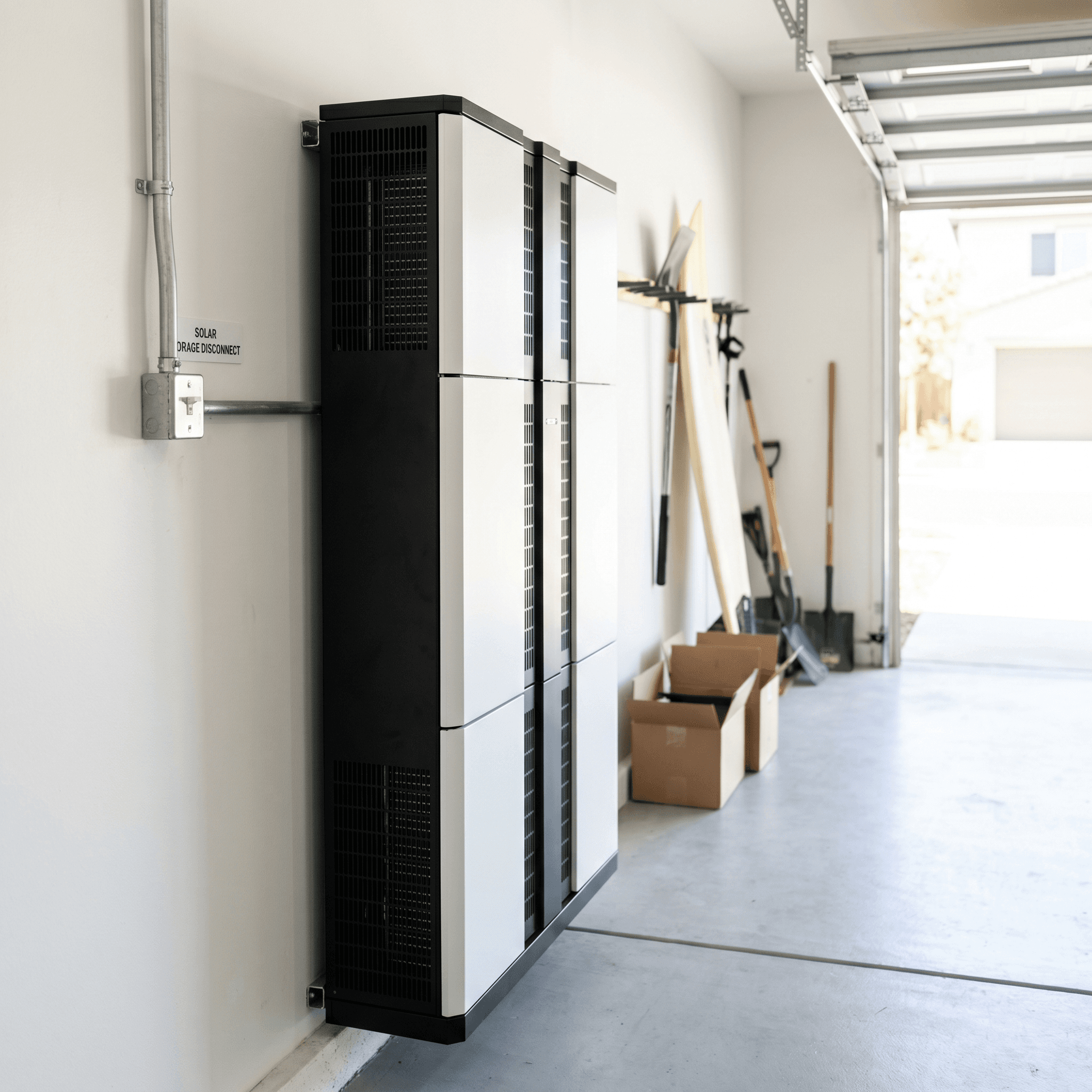
Enphase describes the IQ Battery 5P as having "nearly 34% greater energy density than its predecessor" — per enphase.com/homeowners/home-solar-batteries. In practical terms, this means you get more usable energy per cubic foot of wall space than earlier Enphase battery generations. For LA and Orange County homes where garage and utility room space is at a premium, this matters more than the spec sheet suggests. Multiple 5P units can stack in the same footprint where fewer of the prior generation fit.
The 5P is also the "first microinverter-based storage system to meet the performance criteria of the UL 9540A," per the same Enphase page. UL 9540A is the test method for evaluating thermal runaway fire propagation — it is the certification that determines whether a battery is safe for indoor and enclosed-garage installation in a residential wall-mounted configuration. For California homeowners, this is meaningful: many jurisdictions in LA County require UL 9540A compliance for residential battery installations in attached garages or interior utility rooms.
How the IQ Battery 5P fits into NEM 3.0 / Net Billing economics
The single most important context for understanding why the IQ Battery 5P has gained traction in Southern California is the Net Billing Tariff (NBT), which replaced NEM 2.0 for new solar customers starting April 15, 2023, under CPUC Decision D.22-12-056. Under the prior NEM 2.0 tariff, solar customers received retail-rate credits for every kilowatt-hour they exported to the grid — which made large solar systems with minimal storage economically attractive. The NBT fundamentally changed that math.
"Compensation for excess generation exported to the electric grid is applied to a customer's bill at a rate reflecting the value of this generation to the grid. The value of the export compensation...is usually lower than the retail rate...but can rise above the retail rate on late summer evenings." — CPUC, cpuc.ca.gov/nem
That single sentence explains why nearly 70% of NBT customers had paired battery storage with solar by the end of 2024, per the CPUC's own reporting. When you export solar power at midday, you receive less than retail rate for it. When you discharge stored energy during the late-afternoon and evening peak window — when export and on-peak rates are highest — you offset electricity you would otherwise be purchasing at retail. The battery transforms a low-value midday solar surplus into a high-value evening offset.
The midday-to-peak shift: how the IQ Battery 5P earns its keep
Solar panels in Southern California produce maximum output roughly between 10 a.m. and 2 p.m. — when the sun is highest and grid demand is moderate. Under the NBT, that midday export earns you below-retail export credits. But the CPUC confirms export credits "can rise above the retail rate on late summer evenings" — meaning the same stored energy dispatched in the evening window is worth significantly more on your bill than it would have been if exported at noon. The IQ Battery 5P charges on cheap midday solar and holds that energy to deploy when it counts most.
The CPUC is explicit about the strategy: "Customer-generators can maximize bill savings under the NBT by installing battery storage along with their generation, so they can use or export stored energy during these high-value hours." This is not an installer's sales pitch — it is the CPUC's own description of the correct approach to economics under the tariff it administers. For a detailed walkthrough of how NEM 3.0 reshapes the solar investment case, see our post on how NEM 3.0 changed solar economics in Southern California.
AC coupling and retrofits: The IQ Battery 5P is an AC-coupled system, meaning it connects to the AC electrical panel rather than directly to the DC output of your solar array. This has one significant implication for existing solar owners: you do not need to replace your current inverter system to add an IQ Battery 5P. Homeowners who installed solar under NEM 2.0 — often with a non-Enphase inverter — can still add the 5P to capture the storage benefit under the NBT without a complete system overhaul. For new installations, our team at Anca Solar designs solar and battery systems together from the start, which lets us optimize the sizing for your specific load and rate schedule. If you are starting fresh, our solar panel installation service can be paired with battery storage from day one.
Sizing your system: how many IQ Battery 5P units does a SoCal home need?
The IQ Battery 5P is a modular system — you stack multiple units to reach the capacity your home requires. Each unit adds 5.0 kWh of usable energy and 3.84 kW of continuous power. How many units you need depends on two distinct questions: how much energy you want to shift from midday to evening for bill savings, and how much backup capacity you want for grid outages. Those answers are not always the same.
Sizing for NEM 3.0 bill optimization
For a typical Southern California home consuming 25–35 kWh per day (an LA Basin average for a 1,500–2,500 sq ft house with central A/C), evening loads between 5 p.m. and 10 p.m. typically account for 30–45% of daily consumption — roughly 8 to 15 kWh. Two to three IQ Battery 5P units (10–15 kWh) cover the majority of that evening load from stored solar. This is the sweet spot where the financial return on the battery investment is strongest under the NBT: you are displacing the most expensive electricity you would otherwise have purchased from the grid.
One unit (5.0 kWh): Covers essential evening loads — refrigerator, lights, phone and laptop charging, a ceiling fan. Appropriate for a small home or condo, or for a homeowner primarily focused on partial evening offset rather than full backup capability.
Two units (10.0 kWh): Covers most of a typical evening load profile including a 2-ton A/C running for 3–4 hours, plus appliances and lighting. The most common configuration we see on 1,500–2,000 sq ft homes in Eagle Rock, Pasadena, and the San Gabriel Valley.
Three units (15.0 kWh): Covers a full evening cycle for a larger home, or provides one overnight cycle of essential loads during an extended grid outage. Well-suited for homes with larger A/C systems or higher baseline consumption.
Four or more units: Designed for whole-home backup through a full night and into the next morning, or for homes with high continuous loads like a pool pump, EV charging, or a home office with dedicated circuits. The IQ Battery 5P has a modular design for flexible system sizing — check the current Enphase datasheet for the maximum configuration supported per installation.
Sizing for backup power during outages
Backup capability requires one additional component: the IQ System Controller 3 (or 3G). Per Enphase's product page, the IQ Battery 5P provides "backup capability when installed with IQ System Controller 3/3G." Without the System Controller, the battery still delivers full bill-optimization performance — it charges on solar during the day and discharges during peak hours — but it will not island and keep your home powered when the grid goes down. The System Controller handles the automatic transfer switch function that disconnects your home from the grid and transitions to battery+solar backup within milliseconds of an outage.
The IQ Battery 5P also includes Storm Guard — a feature that monitors National Weather Service alerts and automatically charges the battery to full capacity before a storm arrives. For homeowners in fire-prone hillside neighborhoods across Ventura County, the hills above Pasadena, and the foothill communities around Glendora and Claremont, having a full battery before a high-wind red flag event is not a luxury — it is the kind of preparedness that keeps a refrigerator running and a CPAP machine on when SCE's Public Safety Power Shutoff protocol takes the grid down.
For a detailed approach to matching battery capacity to specific loads and backup duration, our post on sizing home battery storage in Southern California walks through the math room by room.
IQ Battery 5P vs. Franklin WH aPower2: head-to-head comparison
The Franklin WH aPower2 is the most direct alternative to the IQ Battery 5P that we can responsibly compare — both are confirmed on the SGIP Public Equipment List as of April 2026, both are AC-coupled, and both carry 15-year warranties. They serve meaningfully different use cases, and the right choice depends on your home size, load profile, and whether you prioritize modularity or maximum per-unit capacity.
Here is what the confirmed data shows:
Capacity per unit: 5.0 kWh (5P) vs. 15.0 kWh (aPower2). The Franklin WH aPower2 delivers three times the energy per unit. For a homeowner who wants to reach 15 kWh of storage in a single cabinet, the aPower2 does it in one unit; the 5P requires three. For a homeowner who wants to start at 5 kWh and add capacity over time as budget allows, the 5P's modular approach works better.
Continuous power: 3.84 kW (5P) vs. 10 kW (aPower2). This is the most significant functional difference for whole-home backup. The Franklin WH aPower2's 10 kW continuous output can run a 3-ton central A/C system, a full kitchen, and a home office simultaneously. A single 5P unit cannot. For large homes with high simultaneous load demands during an outage, the aPower2's power capacity is a meaningful advantage. Note that stacking multiple 5P units raises the combined continuous power proportionally — two units deliver 7.68 kW, three units deliver 11.52 kW — so the gap narrows with system size.
Inverter architecture: 6 embedded microinverters (5P) vs. external aGate inverter (aPower2). The Enphase approach distributes inversion across six small microinverters inside the battery; the Franklin WH approach uses a separate gateway inverter (the aGate). Both work. The microinverter-based design means the 5P keeps the entire system on a single Enphase Enlighten monitoring platform — valuable if you are already running Enphase solar.
Weather rating: NEMA 3R (5P) vs. IP67 (aPower2). IP67 means the aPower2 is rated against temporary water immersion — per franklinwh.com, "from water immersion up to 3.3 ft for 30 minutes." NEMA 3R covers rain, sleet, snow, and ice formation but does not include submersion protection. For standard SoCal outdoor installations, NEMA 3R is entirely adequate — Southern California is not a flood-prone climate for most residential installations. The IP67 rating matters more in coastal flood zones or areas with drainage issues.
Scalability: Modular with flexible sizing (5P) vs. up to 15 units / 225 kWh (aPower2). Franklin WH confirms its aPower2 scales "up to 15 aPower batteries per aGate for 225 kWh" — appropriate for homes with very high storage demands or commercial-adjacent applications. The 5P scales modularly — consult the current Enphase datasheet for the supported maximum per installation.
Battery chemistry: Lithium Iron Phosphate confirmed for aPower2; verify for 5P. Franklin WH confirms "Lithium Iron Phosphate (LFP) Battery Technology" on its product page. Enphase's publicly accessible homeowners pages did not explicitly confirm the 5P's chemistry by name during our research. Check the current Enphase datasheet for the confirmed chemistry specification.
SGIP eligibility: Both confirmed. Both the IQ Battery 5P and the Franklin WH aPower2 appear on the SGIP Public Equipment List as of April 2026. Both carry 10-year performance warranties — a mandatory SGIP requirement. Both qualify for SGIP rebates, subject to available funding in your utility territory. Specific SGIP rebate amounts depend on the funding step and budget category at the time of application; see our SGIP rebate guide for current details.
"The IQ Battery 5P is the right choice for a home already running Enphase solar that wants to grow storage capacity incrementally and stay on one monitoring platform. The Franklin WH aPower2 is the right choice for a large home that needs maximum continuous power output from day one. Neither is wrong — they are designed for different starting points."
When the 5P wins: You already have Enphase microinverters. You want to add storage in phases as your budget allows. You have a 1,200–2,000 sq ft home with moderate A/C loads. You want the unified Enphase Enlighten monitoring dashboard for your entire solar-plus-storage system. You value the UL 9540A fire propagation certification for an indoor or enclosed-garage installation.
When the aPower2 wins: You have a large home (2,500 sq ft or more) with high simultaneous backup load requirements. You want maximum storage in the fewest units. Your home has non-Enphase solar already installed and you are not planning to replace it. Your primary concern is a high continuous power output during extended outages rather than incremental bill optimization.
Incentives in 2026: SGIP and what is not available anymore
California's incentive landscape for battery storage changed significantly at the end of 2025. Here is an honest accounting of what is and is not available as of May 2026.
SGIP: The IQ Battery 5P is confirmed eligible
The Self-Generation Incentive Program (SGIP) is California's primary state-administered financial incentive for residential battery storage. As of April 15, 2026, the IQ Battery 5P appears on the SGIP Public Equipment List maintained by selfgenca.com, confirming the 5P is eligible for SGIP rebates. The SGIP equipment list also confirms the 5P carries a 10-year performance warranty, which is a mandatory requirement for SGIP qualification.
One important note from the SGIP equipment list: the entry for the IQ Battery 5P includes the notation "IQ System Controller required for resiliency." For homeowners applying under SGIP's Equity Resiliency budget — which targets low-income customers in high fire threat districts, among other criteria — the System Controller is not optional. It is required to qualify for that funding track.
What we cannot tell you in this post: the specific dollar-per-kWh SGIP incentive rate your system will receive. SGIP incentives are structured in "steps" — as funding is reserved, the per-kWh rate drops. General residential market SGIP rates vary by utility territory and current step availability. The CPUC has authorized $280 million for the Residential Solar and Storage Equity budget with reservations opening June 2, 2025 — but that equity track has specific income and geography eligibility requirements and is not available to all residential customers. For the current SGIP step and available incentive level in your utility territory, our post on the SGIP battery rebate in California 2026 has the latest detail — or contact your utility directly (SCE residential SGIP: SGIPGroup@sce.com; LADWP: sgip@ladwp.com).
If you are a Pasadena Water and Power customer, the utility has its own separate battery rebate program — see our post on the PWP solar and battery rebate program for current details.
Federal ITC: Not available for systems installed after December 31, 2025
The federal residential clean energy tax credit — commonly referred to as the 30% ITC — was not extended and expired on December 31, 2025, under H.R. 1. For battery storage systems installed in 2026, the federal ITC is not an available incentive. We will not pretend otherwise. If your installer is still quoting a "30% federal tax credit" for a 2026 installation, that requires immediate clarification. Consult a licensed tax professional for your specific situation, but as of the date of this post, the federal credit is not available for new residential solar or storage installations.
State-level incentives — SGIP and utility-specific programs — remain the primary financial tools available to SoCal homeowners in 2026. We are tracking any legislative developments that could change this, and will update our posts when the picture changes.
What this means for you
The Enphase IQ Battery 5P is a well-specified, proven product with confirmed SGIP eligibility and a financial case that is tightly aligned with how Southern California's Net Billing Tariff actually works. Its modular architecture makes it a practical path for homeowners who want to start with one or two units and expand capacity over time — or for those who already have Enphase solar and want to add storage without changing their core system. The backup capability via the IQ System Controller 3, combined with Storm Guard's pre-event charging, is directly relevant in a region where Public Safety Power Shutoffs and wildfire-season outages are a recurring reality.
At Anca Solar, we design and install solar and battery systems across Los Angeles, Orange, and Ventura Counties. We have been doing this work for more than 25 years, and we have watched the incentive landscape, the tariff rules, and the battery technology evolve through multiple cycles. If you are evaluating the IQ Battery 5P — whether as a retrofit to existing solar or as part of a new system — we can help you size it correctly for your home, confirm your SGIP eligibility, and give you a straightforward quote. Learn more about our team and how we approach each installation. Schedule a free solar consultation with Anca Solar — we serve homes throughout the LA Basin, Orange County, and Ventura County. (CSLB License #873768.)
Subscribe to our newsletter
Sign up to get the most recent blog articles in your email every week.